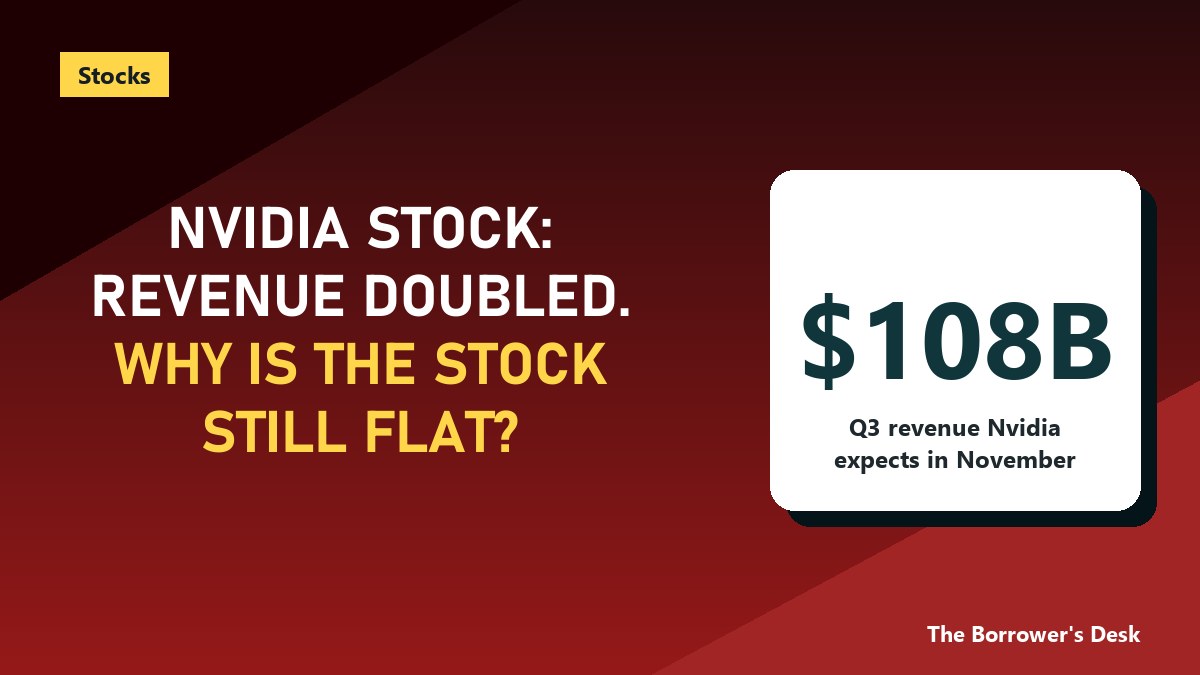
Nvidia closed at $204.64 on Friday, October 30, down 4.2% on the day. A year earlier the stock traded at almost the same price. In that year the company’s quarterly revenue more than doubled, from $46.7 billion to $96.2 billion. So the business is twice as big and the stock went nowhere.
That gap is the whole story going into Nvidia’s next earnings report, expected in the second half of November. The company had not confirmed the date as of October 31. What follows is what Nvidia has told investors to expect, what Wall Street thinks the shares are worth, and the numbers that could move the price either way.
Nvidia’s last quarter in numbers

For the quarter that ended July 26, 2026, Nvidia reported revenue of $96.2 billion. That was up 106% from the same quarter a year before and up 18% from the quarter before it. Data center sales, the AI chips and networking gear that big cloud companies buy, were $89.0 billion of that. Everything else, which Nvidia now groups as edge computing and which includes its robotics and automotive products, brought in $7.2 billion.
Profit kept pace. Gross margin was 75.0%. Adjusted earnings came to $2.22 a share, and $2.46 under standard accounting. Nvidia also spent about $26 billion buying back its own stock and paying dividends during the quarter, with roughly $99 billion still approved for future buybacks. Those figures come from the company’s own results release.
One note on the calendar. Nvidia’s fiscal year ends in late January, so “fiscal 2027” is mostly calendar 2026. The quarter reporting in November is fiscal third quarter 2027, covering August through late October.
What Nvidia expects for the November report
The guidance is $108.0 billion in revenue, plus or minus 2%. That works out to a range of about $105.8 billion to $110.2 billion. Gross margin is expected near 74%, a point lower than last quarter, which is normal when a new chip generation is ramping and early units cost more to build.
Two details in that forecast matter more than the headline.
First, it assumes zero data center compute sales to China. Export rules have kept Nvidia’s most capable chips out of that market, and management has stopped counting on it. If any China revenue shows up, it’s extra. If it never does, the forecast already accounts for that.
Second, Vera Rubin, the chip family that follows Blackwell, is now in full production. Nvidia says racks are being installed at CoreWeave, Google Cloud, Microsoft Azure, Oracle Cloud and Nebius. How fast those shipments grow will show up first in the data center line.
Compared with a year ago the jump is enormous. In the third quarter of fiscal 2026 Nvidia had $57.0 billion in revenue. Hitting $108 billion would mean growth of almost 90%. For a company valued at around $5 trillion, that pace is hard to find anywhere else in the market.
Investors have also learned to treat the guidance as a floor. Nvidia has finished above the top of its own range quarter after quarter, so the stock usually reacts to how far above $108 billion the number lands, and to next quarter’s forecast, more than to the result alone. A quarter of $110 billion could still disappoint if the market was hoping for $113 billion.
Why the stock fell anyway
October 30 was a rough day for chips in general. Intel’s results disappointed and pulled the whole semiconductor group lower, and the selloff fed an argument that has followed Nvidia all year: the companies buying these chips are spending hundreds of billions on data centers, and nobody has proven yet that AI will earn that money back.
Nvidia’s results don’t really answer that question, because its revenue is someone else’s spending. If Microsoft, Google, Amazon and Meta keep raising their budgets, Nvidia keeps growing. If one of them blinks, the forecast changes fast. Amazon and Alphabet both kept their spending plans when they reported in late October, which helps, but the market has been trading on mood as much as on orders.
That’s also why the stock swings so much. Its five-year beta is about 2.2, meaning it has tended to move a bit more than twice as much as the overall market. A 4% drop in a single day on no company news isn’t unusual for it.
Is Nvidia expensive at $204?

Less than it looks. At the October 30 close, Nvidia was worth about $4.94 trillion. Over the last twelve months it earned $7.91 a share, so the trailing price to earnings ratio is about 26. That’s high for the S&P 500 but low for a company growing this fast.
The forward number is lower still. Analysts expect enough profit over the coming year that the stock trades at about 17 times forward earnings, which implies roughly $12 a share. When the stock stayed flat while earnings doubled, the valuation shrank. A year ago investors paid a much richer multiple for the same company.
The obvious catch is that forward earnings are an estimate, and estimates for chip companies have a way of falling apart at the top of a cycle. A multiple of 17 is cheap only if the profits arrive.
What analysts expect from the stock
Wall Street is still almost all bullish. The average 12 month price target sits at about $321 to $329 depending on the data provider, with MarketBeat’s average of $321.47 drawn from 55 analysts. From $204.64, that’s an upside of more than 55%.
The range is wide, though. The lowest target on record is $180, about 12% below Friday’s close, and the highest is $515. Barclays reaffirmed a buy rating with a $275 target on October 27. Price targets tend to trail the stock rather than lead it, so treat the average as a measure of sentiment more than a forecast.
What would move the price after earnings
A few things are worth watching when the report comes out.
The first is the size of the beat. Revenue near or below $108 billion would probably be read as a slowdown, even though it would still be close to double last year. Something in the $111 billion to $113 billion area is what a stock this widely owned usually needs to go up.
The fourth quarter forecast matters at least as much. If Nvidia guides above $120 billion, it tells the market that Rubin demand is on top of Blackwell, not replacing it.
Gross margin comes next. Guidance is 74%. A miss of a point or two would suggest Rubin is costing more to ramp than planned. Holding near 75% would quiet that worry.
Customer spending plans round it out. Nvidia reports in the same weeks that its biggest buyers update investors. Any cut in their capital budgets would hit the shares before Nvidia says a word.
None of this tells you where the stock goes next. It tells you what the market will be measuring it against.
Questions people ask about Nvidia stock
When is Nvidia’s next earnings date?
Nvidia hasn’t announced it yet. Trackers put the fiscal third quarter report somewhere between November 17 and November 25, 2026, after the market closes, and the company usually confirms the date three to four weeks ahead on its investor relations site.
Does Nvidia pay a dividend?
Yes, but it’s small next to the share price. Most of the money Nvidia returns to shareholders goes into buybacks, which reduce the share count and lift earnings per share over time.
Is Nvidia a good stock to buy for a beginner?
It depends on how much of your money is in it. A single stock that can drop 4% in a day and has fallen 30% or more more than once in the past few years isn’t a place for money you’ll need soon. Many people get Nvidia exposure through an S&P 500 or Nasdaq 100 index fund, where it’s already one of the largest holdings. Our guide to starting with $100 covers that route.
How are Nvidia gains taxed if I sell?
Shares held longer than a year are taxed at long term capital gains rates of 0%, 15% or 20% depending on your income. Shares sold sooner are taxed as ordinary income. The numbers are worked out in capital gains tax on stocks for 2026.
Related reading
- How Fast Can Your Money Grow by Investing?
- How Much Money Do You Need to Start Investing in the U.S.?
- Can You Make $1,000 a Month Stock Trading? Running the Math
Prices are from the October 30, 2026 close and change every trading day. This article is general information, not a recommendation to buy or sell any stock. Check the latest filings and talk to a licensed adviser before you invest. See our disclaimer.

Leave a Reply