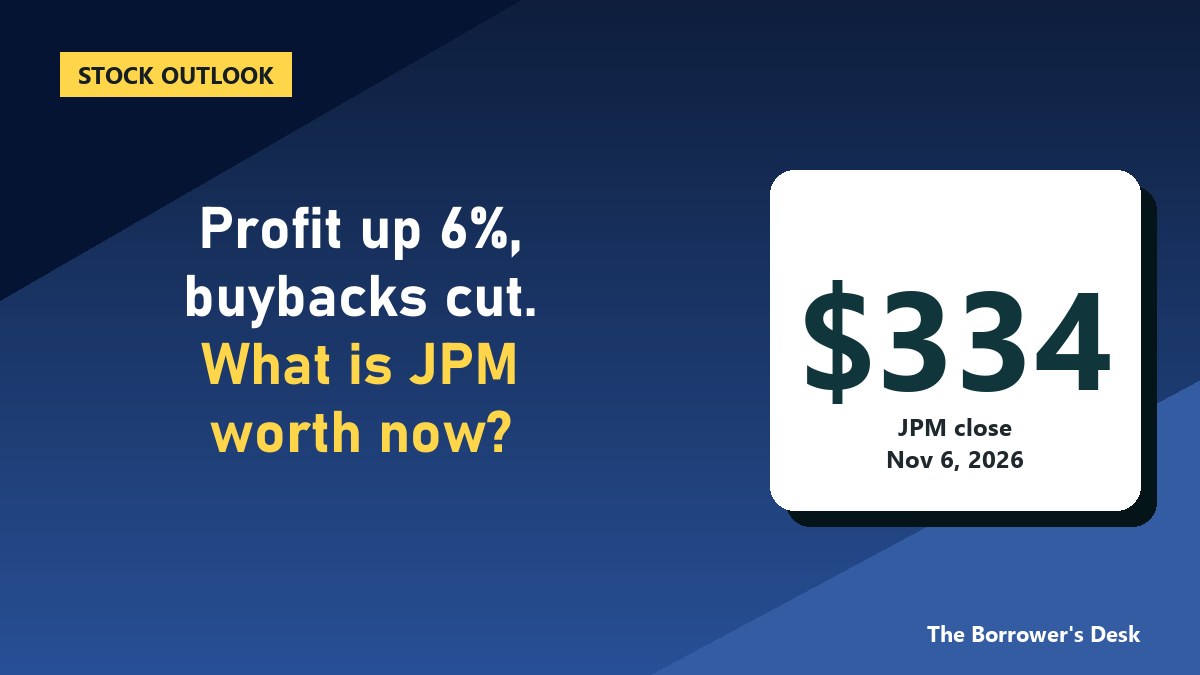
JPMorgan Chase earned $15.3 billion in the third quarter. Profit rose 6%, earnings per share rose 10%, and the bank raised its dividend. The stock still slipped.
Shares closed at $334.49 on November 6, after a 4.19% drop on November 5 and another small loss the next day. At that price JPM trades a little under where analysts had put their average target in September, which tells you the market already thinks the easy gains are behind it.
Below is what the bank reported, what it said about the rest of 2026, why buybacks shrank, and how the stock looks at roughly $334.
The third quarter in numbers

According to JPMorgan’s earnings release filed with the SEC on October 13, reported revenue was $50.2 billion, up 8% from a year earlier. On the managed basis the bank prefers, which adjusts for tax equivalent income, revenue was $50.9 billion.
Net income was $15.3 billion, or $5.57 a share, compared with $14.4 billion and $5.07 a year ago.
That figure includes a $658 million loss on investment securities sold by the Treasury and Chief Investment Office group. After tax it cost about $498 million, or 18 cents a share. Strip it out and earnings were $5.75 a share.
Analysts had expected around $5.90 on that adjusted basis, so this was a miss, not a beat. Revenue on the managed basis landed roughly where the street expected.
Return on tangible common equity, the number bank investors watch most, was 20% as reported and 21% without the securities loss. Very few large banks anywhere earn that much on their capital.
Where the money came from
Net interest income, the spread between what the bank earns on loans and securities and what it pays on deposits, was $27.0 billion, up 13%. Excluding the trading desk, it was $24.7 billion, up 6%. Higher deposit balances, card lending and wholesale loans all helped.
The trading business had another big quarter. Markets revenue was $10.3 billion, up 15%. Equities did the heavy lifting with a 49% gain, while fixed income slipped 4%.
Investment banking fees were about $3.0 billion, up 14%, as deal activity kept recovering.
By segment:
- Corporate and Investment Bank: net income of $8.25 billion, up 20%
- Consumer and Community Banking: $5.67 billion, up 13%
- Asset and Wealth Management: $1.84 billion, up 11%
- Corporate: a $455 million loss, mostly from the securities sale
The consumer bank is the part most people know: Chase checking accounts, credit cards, mortgages and auto loans. A 13% profit gain there suggests American households were still paying their bills through the summer.
Credit is holding up
The provision for credit losses was $2.7 billion, down 19% from a year earlier. Net charge offs, the loans the bank wrote off as lost, were $2.2 billion, down $389 million. The card charge off rate was 2.91%.
The bank still added $539 million to reserves. That is not a sign of trouble so much as a bank growing its loan book and setting money aside for it.
Jamie Dimon’s tone was cautious anyway. In the release he wrote that “large fiscal deficits, sticky inflation, elevated asset prices, rising interest rates and geopolitical conditions continue to shift under the surface.” He added: “These forces may be manageable, but we remain prepared for a wide range of outcomes.”
He has written versions of that paragraph for years. It is worth reading as a description of how JPMorgan runs its balance sheet rather than as a forecast.
The expense problem
Noninterest expense was $27.3 billion, up 12%. Revenue grew 8%. When costs rise faster than sales, margins get squeezed, and that gap is probably the main reason the stock did not reward the quarter.
The overhead ratio, expenses as a share of revenue, was 54%.
Some of the spending is deliberate. JPMorgan keeps opening branches, hiring bankers and spending on technology. It also agreed in January to take over the Apple Card program from Goldman Sachs, which brings costs before it brings much revenue. According to coverage of the call, management raised its full year adjusted expense estimate to about $108.6 billion, from about $107.5 billion in July.
What the bank expects for the rest of 2026

JPMorgan’s quarterly report puts 2026 net interest income at about $106.2 billion, and about $97.2 billion excluding Markets. Both are labeled market dependent. That implies roughly $28 billion of net interest income in the fourth quarter.
The bank does not give earnings guidance, so there is no official profit target for the year or for 2027.
The interest income outlook is good news for now. The risk sits further out. If rates fall in 2027, deposit spreads usually compress, and net interest income becomes harder to grow.
Why buybacks dropped
This is the part of the report that got less attention than it deserved.
JPMorgan bought back a net $664 million of its own stock in the quarter. For a company worth close to $900 billion, that is very little. Dimon said plainly, “we reduced share repurchases this quarter.”
The bank is sitting on a lot of capital. Its standardized CET1 ratio was an estimated 13.9%, with $304 billion of CET1 capital. Dimon said he believes the bank “can deploy this capital over time at very attractive returns for our shareholders.”
His view, which he has repeated often, is that buying back stock at around three times tangible book value is not a great deal. He would rather lend the money, keep it in reserve for a downturn, or use it when prices are lower.
For shareholders, that cuts both ways. Fewer buybacks mean slower growth in earnings per share. But a bank that holds extra capital going into an uncertain economy can buy assets cheaply if something breaks.
The dividend went up. JPMorgan declared $1.65 a share for the quarter, up from $1.50. At $334.49 that works out to about $6.60 a year and a yield of about 2.0%.
What JPM is worth at $334
Banks are usually valued against their book value, not just their earnings.
Tangible book value was $112.64 a share at the end of September, up 7% from a year earlier. At $334.49, the stock trades at about 2.97 times tangible book. Book value per share was $132.30, so the price is about 2.5 times book.
That is expensive for a bank. It is also what a 20% return on tangible equity tends to earn. A bank that earns 10% on equity usually trades near tangible book. One that earns double that gets a premium.
A simple way to frame earnings: if you take the adjusted $5.75 from the third quarter and multiply by four, you get $23 a share. The stock would be trading at about 14.5 times that figure. That is only arithmetic on one quarter, not a forecast, and the fourth quarter will look different.
Analysts have not seen much upside. In September, Benzinga’s tally showed an average price target of $340 from 16 analysts, with 10 rating the stock a buy and 6 a hold. In July, S&P Global data showed 12 month targets ranging from $305 to $418. Both are a few months old now, and targets tend to move after each earnings report.
Risks to watch
- Costs: if expenses keep growing faster than revenue, return on equity drifts down from 20%.
- Rates: falling rates in 2027 would make the $106 billion level of net interest income harder to repeat.
- Credit: card losses are low today. A weaker job market would change that quickly, and the reserve builds would get bigger.
- Trading: Markets revenue has been unusually strong. It can swing hard from quarter to quarter.
- Valuation: at almost three times tangible book, the stock has little cushion if earnings disappoint.
What this means for investors
JPMorgan is still the most profitable big bank in the country, and the third quarter did not change that. Profit grew, credit losses fell, and the consumer business is healthy.
What changed is the price of that quality. The stock trades at almost three times tangible book, analysts’ average target sits close to the current price, and management itself is signaling that it does not see its shares as cheap enough to buy back in size.
People who already own it are holding a steady dividend payer with a strong balance sheet. People thinking about buying at $334 are paying full price for a bank whose next big move likely depends on rates and the economy more than on anything in this report.
The next earnings report is expected in mid January, with full year 2026 results.
This article is for information only and is not investment advice. Figures come from JPMorgan’s filings and the market data cited above.
If you are looking at other large companies before year end, see our recent outlooks on Apple and AMD, and our guide to the 0% capital gains rate if you plan to sell winners in December.

Leave a Reply