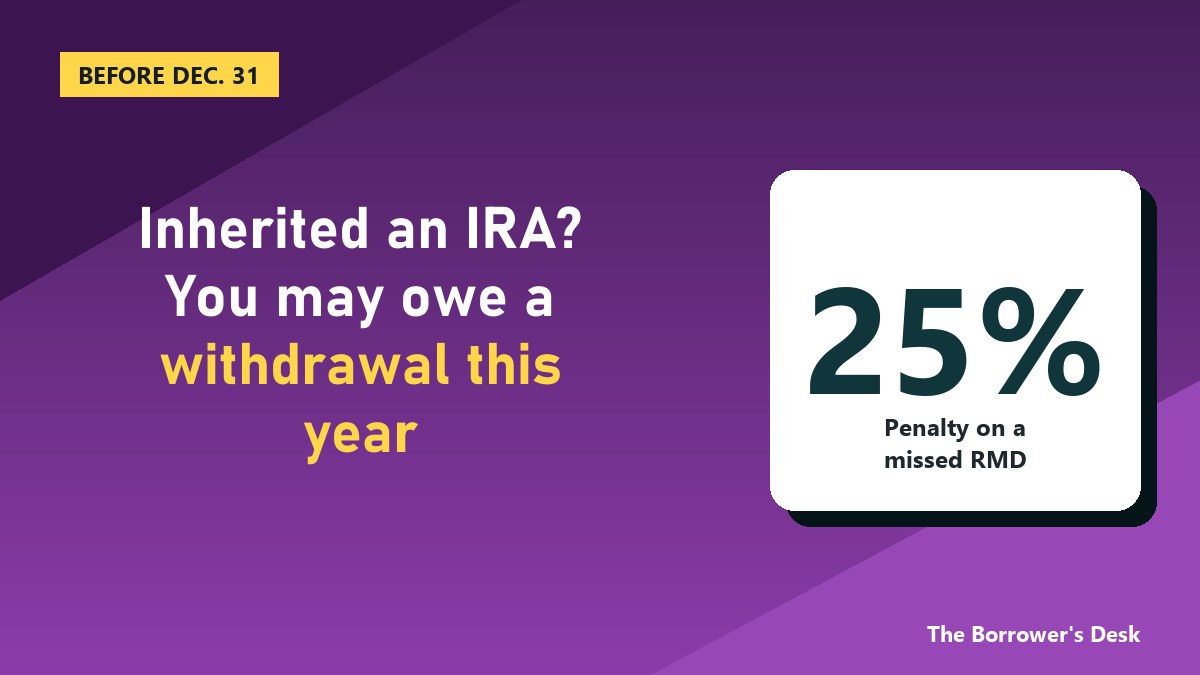
If you inherited an IRA or a 401(k) from a parent, a relative or a friend, you may have a withdrawal that has to come out by December 31, 2026. Many heirs do not know it, because for four years the IRS did not enforce the rule.
That grace period is over. Starting with 2025, beneficiaries covered by the rule have to take a withdrawal every year, and missing one can cost 25% of the amount that should have come out.
Below is who has to take a 2026 distribution, how to figure the amount, and what to do if you already missed one.
Why so many heirs are confused
The SECURE Act changed inherited retirement accounts for owners who died in 2020 or later. Most adult children and other non spouse heirs lost the old “stretch” option and now have to empty the account by the end of the tenth year after the year of death.
For a while, many people read that as “take nothing for nine years, then take it all in year ten.” In 2022 the IRS proposed that some beneficiaries also need yearly withdrawals in between. Because that caught people off guard, the IRS waived the penalty for missed yearly withdrawals for 2021 through 2024, in a series of notices ending with Notice 2024-35.
Final regulations issued in July 2024 kept the yearly withdrawal requirement and made it apply starting in 2025. So 2026 is the second year it counts.
Who has to take money out in 2026

Your 2026 withdrawal, if any, depends on who you are and when the original owner died.
You need a yearly withdrawal under the 10 year rule if:
- You are a non spouse beneficiary who is not in one of the special groups below, such as an adult child or a grandchild, and
- The owner died in 2020 or later, and
- The owner died on or after their required beginning date, meaning they had already reached the age when their own required withdrawals started.
In that case you take a yearly minimum in years one through nine and empty the account by December 31 of year ten.
You do not need a yearly withdrawal, only the 10 year deadline, if:
- The owner died before their required beginning date, or
- The account is an inherited Roth IRA. A Roth owner never has required withdrawals, so the IRS treats them as dying before that date.
You take yearly withdrawals based on your own life expectancy, with no 10 year limit, if you are an eligible designated beneficiary:
- The owner’s surviving spouse
- The owner’s minor child, until age 21, after which the 10 year rule starts
- Someone disabled or chronically ill
- Someone not more than 10 years younger than the owner
You also keep taking yearly withdrawals if you inherited before 2020. Those older “stretch” accounts were not changed by the SECURE Act.
A spouse has more choices, including treating the account as their own. That decision has its own tradeoffs, especially for a spouse under 59 and a half.
How the yearly amount is figured
The custodian holding the inherited account will often calculate the minimum, but it is worth knowing how it works so you can check it.
For a non spouse beneficiary, the minimum is the account balance on December 31 of the prior year divided by a life expectancy factor:
1. Find your age in the year after the owner died. 2. Look up your factor for that age in the IRS Single Life Table, in Publication 590-B. 3. Each later year, subtract 1 from that factor.
Here is a simple example. A daughter inherits her father’s IRA in 2024. He was 80 and already taking his own withdrawals. She turns 50 in 2025, and the Single Life Table factor for age 50 is 36.2.
- 2025 withdrawal: balance on December 31, 2024 divided by 36.2
- 2026 withdrawal: balance on December 31, 2025 divided by 35.2
- If that balance was $300,000, the 2026 minimum is about $8,523
- By December 31, 2034, the account has to be empty
The yearly minimum is small compared with the balance. The real planning question is how fast to drain the account beyond the minimum, which comes up below.
The penalty for missing it

If you do not take a required withdrawal by December 31, the IRS charges an excise tax of 25% of the amount you should have taken. If you take the missed amount and file to report it within the correction window, generally about two years, the tax drops to 10%.
You can also ask the IRS to waive the tax completely if the miss came from a reasonable error and you have fixed it. You do that on Form 5329 by taking the missed amount, attaching a short explanation, and entering the waiver request on the form. The IRS often grants these when the shortfall was corrected quickly.
If you missed your 2025 withdrawal, take it now, in addition to your 2026 minimum. Then file Form 5329 for 2025, with your 2025 return or on its own if you already filed, and request the waiver. Do not just add it to your 2026 withdrawal and assume it is fixed; the form is what reports the correction.
Missed yearly withdrawals from 2021 through 2024 do not have to be made up. The 10 year deadline still applies to the full balance.
Planning the next nine years
Taking only the minimum each year often leaves a large balance for year ten. Since every dollar from a traditional inherited IRA is taxed as ordinary income in the year it comes out, a big final withdrawal can push you into a much higher bracket.
A few ways people approach it:
- Spread it out. Dividing the balance over the remaining years, instead of the minimum, keeps each year’s income steadier.
- Take more in low income years. A year with a job change, a sabbatical or early retirement is a good time to pull more out at a lower rate.
- Watch income lines. Extra income can raise the tax on Social Security benefits, increase Medicare premiums two years later, or cost you credits and deductions that phase out with income. Our list of year end tax deadlines covers other moves that change your 2026 income.
- Give from it if you are older. Beneficiaries who are 70 and a half or older can make a qualified charitable distribution from an inherited IRA. See our guide to qualified charitable distributions for 2026.
- Set withholding. Custodians usually withhold 10% for federal tax by default on IRA withdrawals unless you choose otherwise. That may be too little for a large withdrawal, which can lead to an underpayment penalty. Our tax underpayment penalty calculator helps you check.
An inherited IRA cannot receive new contributions, and a non spouse beneficiary cannot roll it into their own IRA. Moving it from one custodian to another must be done as a direct trustee to trustee transfer into an account titled as inherited.
What to do before December 31
- Find out if the original owner had reached their required beginning date when they died. The custodian or the owner’s last tax return can tell you.
- Confirm which group you are in from the lists above.
- Ask the custodian for your 2026 required amount and check it against the Single Life Table.
- Request the withdrawal early in December, not on the last business day. Custodians get busy, and the money has to leave the account by December 31.
- If you missed 2025, take that amount too and plan to file Form 5329.
- Decide whether to take more than the minimum this year based on your 2026 income.
If you are the account owner rather than an heir, our RMD calculator shows your own 2026 required withdrawal.
This article explains federal rules for inherited IRAs as of November 2026. It is not tax advice. Rules for trusts, estates and multiple beneficiaries are more complex, and a tax professional can help if any of those apply.

Leave a Reply