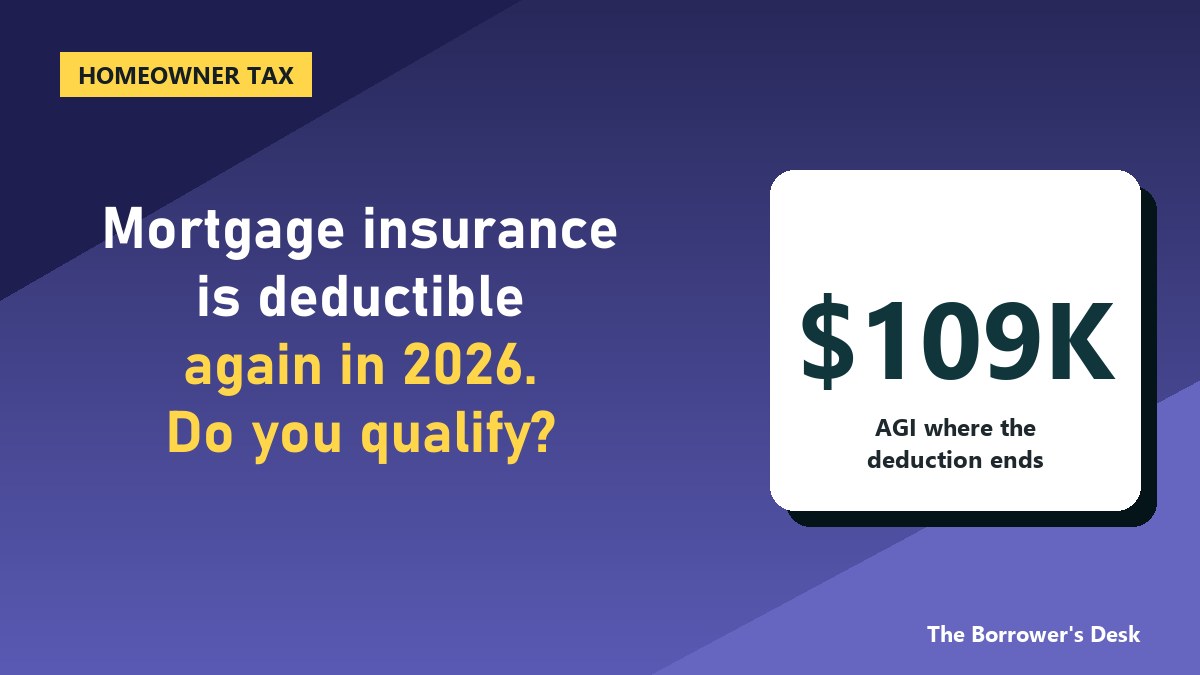
If you put less than 20% down on your home, you probably pay mortgage insurance every month. For four tax years, from 2022 through 2025, that money gave no federal tax break. Starting with 2026 it does again, and this time the deduction has no end date.
There is a catch that many summaries of the 2025 tax law leave out. The old income limit came back with it. The deduction starts shrinking once your adjusted gross income passes $100,000 and is gone at $109,000, and those numbers are not adjusted for inflation.
Here is who can use it, how much it is worth, and the one payment you can make before December 31 to add a month of mortgage interest to your 2026 return.
What changed for 2026

Section 70108 of Public Law 119-21 made two changes to mortgage deductions, both starting with tax years that begin after December 31, 2025:
- Mortgage insurance premiums count as mortgage interest again. The deduction had expired after 2021. It now returns permanently.
- The $750,000 limit on mortgage debt is permanent. Interest on up to $750,000 of debt used to buy, build or improve your home is deductible, or $375,000 if married filing separately. Loans taken out before December 16, 2017 keep the old $1 million limit.
The IRS draft of Publication 936 for 2026 shows the premiums going on Schedule A, line 8d, for amounts paid or accrued in 2026. Premiums you paid in 2025 or earlier are not deductible.
What kinds of mortgage insurance count
The deduction covers premiums on a mortgage insurance contract issued after 2006, tied to a loan used to buy, build or improve your main home or a second home. That includes:
- Private mortgage insurance (PMI) on conventional loans
- FHA mortgage insurance premiums, both the upfront premium and the monthly premium
- VA funding fees
- USDA Rural Housing Service guarantee fees
Your lender reports what you paid in box 5 of Form 1098, the mortgage interest statement you get in January.
Upfront premiums follow a special rule. If you prepaid mortgage insurance that covers years beyond 2026, you spread the deduction over the shorter of the loan term or 84 months. The IRS draft gives an example: $9,240 of PMI prepaid in May 2026 allows $880 for 2026 and $1,320 for 2027. VA funding fees and Rural Housing guarantee fees are the exception. If the contract was issued in 2026, the draft says those can be deducted in full for 2026. The FHA upfront premium does not get that exception.
The income limit

The phase out works in steps. For every $1,000 of AGI over $100,000, or any part of $1,000, you lose 10% of the deduction:
- AGI of $100,000 or less: the full amount
- AGI of $100,500: 90%, because any part of $1,000 counts as a full step
- AGI of $104,500: 50%
- AGI over $109,000: nothing
For married people filing separately the limit is half: the reduction starts at $50,000 and the deduction is gone above $54,500.
The same $100,000 threshold applies to single and joint filers. A married couple earning $110,000 together gets no deduction for mortgage insurance, even though a single person earning $95,000 can deduct all of it.
So the deduction is aimed at buyers with moderate incomes. A household over $109,000 gets nothing from it, however much it pays in premiums.
You have to itemize
Mortgage insurance is an itemized deduction. It only helps if your itemized total, including mortgage interest, state and local taxes and charity, is more than your standard deduction. For 2026 the standard deduction is $16,100 for single filers, $24,150 for heads of household and $32,200 for married couples filing jointly.
That bar is easier to clear in 2026 than it was a few years ago, because the cap on state and local taxes rose to $40,400 for 2026. Two examples show how it plays out.
A single homeowner with $90,000 of AGI pays $11,000 of mortgage interest, $6,500 of property and state income tax, and $1,500 of PMI. Without the PMI, itemized deductions are $17,500, already above the $16,100 standard deduction. So all $1,500 of PMI adds to the deduction. In the 22% bracket, that cuts federal tax by $330.
A married couple with $95,000 of AGI pays $14,000 of mortgage interest, $9,000 of state and local tax, and $1,800 of PMI. Their total is $24,800, well under the $32,200 standard deduction. The PMI deduction does nothing for them, and they should take the standard deduction.
If your total comes close, our SALT deduction calculator gives your 2026 state and local tax figure, and our guide to prepaying property taxes before December 31 explains when moving a tax bill into 2026 tips the balance.
Pay your January mortgage payment in December
Mortgage interest is paid in arrears. The payment due January 1, 2027 covers interest for December 2026. If your lender receives that payment by December 31, 2026, the December interest generally counts as paid in 2026.
The IRS rule in Publication 936 is that interest paid in advance for a period after the end of the year has to be spread to that period. The draft 2026 version says you can’t deduct prepaid interest for January 2027 in 2026. Paying the January 1 payment early moves interest for December, a month that is already over by December 31, so it stays within the rule. Paying your February payment early would not work, since that covers January 2027 interest.
The Form 1098 instructions back this up from the lender’s side. Interest received in December that accrued by December 31 is reported on that year’s form, even if it is not due until later.
How much does it move? On a $300,000 loan at 6.5%, one month of interest is about $1,625. For a single filer in the 22% bracket who itemizes, that is about $357 of tax shifted into 2026.
Three cautions:
- It only helps if you itemize in 2026. If you take the standard deduction anyway, an extra month of interest changes nothing.
- It borrows from 2027. Unless you repeat it every year, your 2027 return will have one fewer month of interest. It works best in a year you itemize followed by a year you will not.
- Check how your lender applies it. Make sure the payment is applied as the January installment, not as extra principal, and that it posts by December 31. Mailing a check on December 30 is risky.
What to do before December 31
1. Find your 2026 AGI estimate. If it will be well over $109,000, the mortgage insurance deduction will not apply, though the mortgage interest still does. 2. Add up your itemized deductions. Use your latest mortgage statement for interest and PMI paid so far, and add the remaining months. 3. Compare with your standard deduction. If you are within a few thousand dollars, the January payment and a property tax payment made in December may push you over. 4. Look at dropping PMI altogether. Under the federal Homeowners Protection Act, on a conventional loan lenders generally must drop PMI once the balance reaches 78% of the original value, and you can ask for it to be removed at 80%. A deduction is worth something, but no premium is worth more.
Records to keep
Keep your December 2026 and January 2027 statements showing when the payment posted, and your Form 1098 for 2026. If you refinanced or bought in 2026, keep the closing disclosure showing any upfront mortgage insurance or funding fee.
This article explains federal rules for tax year 2026 under Public Law 119-21 and the IRS draft of Publication 936 for 2026, which can still change before it is final. State tax treatment can differ, and it is not tax advice for your situation.

Leave a Reply