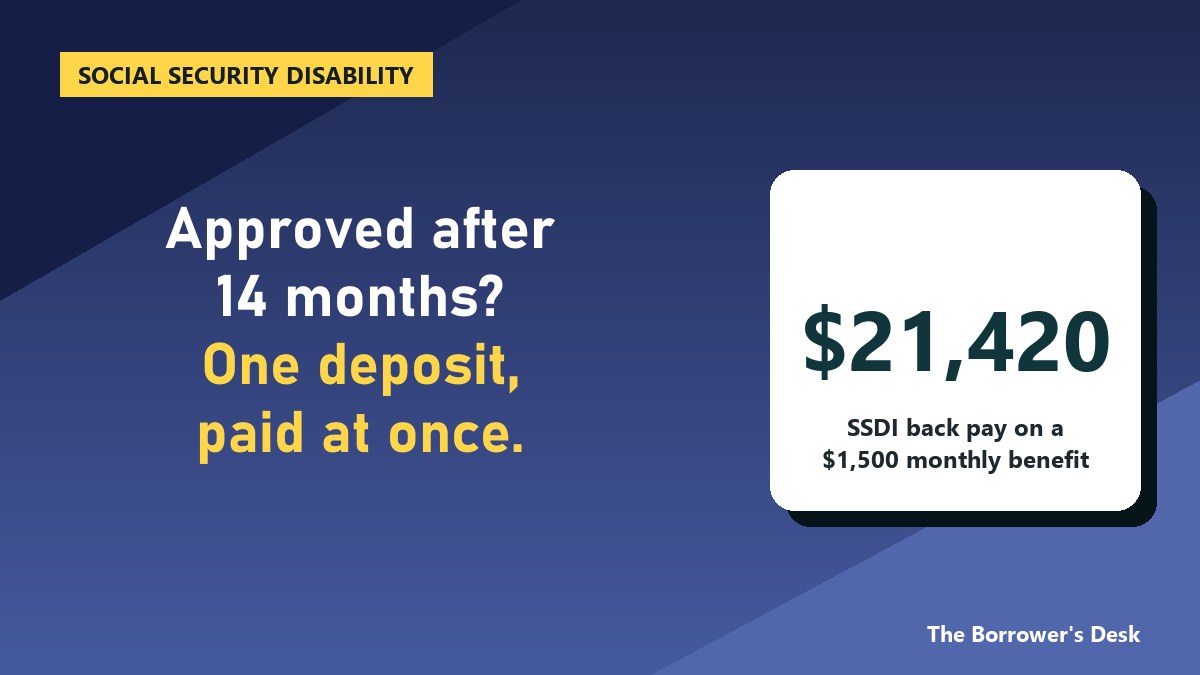
A worker whose SSDI benefit is $1,500 a month and who waits 14 months for approval can get one deposit of about $21,420 in back pay. That money is real, it arrives all at once, and three rules decide how much of it you keep: a five month wait that is never paid back, a 12 month limit on how far back Social Security will go, and a fee for your lawyer that is capped at $9,200.
Most people who apply for disability spend their energy on the medical side of the claim. The money side gets less attention, and that is where avoidable losses happen. Apply a year late and you can lose months for good. Receive the lump sum in the wrong tax year and you may pay tax you did not have to. Get SSI instead of SSDI and the back pay may come in pieces, six months apart.
This guide walks one claim from the day the disability starts to the day the money lands, then covers the parts that surprise people.
Step one: the month your disability began
Everything is counted from your established onset date, the date Social Security agrees you became unable to work at the level it calls substantial gainful activity. You list a date on the application. The examiner or judge may accept it or pick a later one based on your medical records, and that choice moves the back pay more than anything else.
Under 42 USC 423(c)(2), SSDI has a waiting period of five full calendar months. If your disability began on March 10, March is not a full month, so the waiting period runs April through August. Your first month of entitlement is September. If the disability began on the first day of a month, that month counts as the first of the five.
Those five months are never paid. Not in back pay, not later. There are two exceptions: people with ALS have had no waiting period since July 2020, and someone who was entitled to SSDI before and becomes disabled again within five years does not serve a second one.
SSI, the needs based program, has no waiting period. It has a different limit, covered below.
Step two: the date you applied

SSDI can pay up to 12 months before the month you apply, under 20 CFR 404.621, but never for a month inside the waiting period. So the first paid month is the later of two dates: the month after the waiting period ends, or 12 months before your application.
That is why applying late costs money. Take two people whose disability began on March 10, 2025:
- Applied in September 2025. Entitlement starts in September 2025, right after the waiting period. Nothing is lost.
- Applied in December 2026. Twelve months back from December 2026 is December 2025. Entitlement starts there, and the months from September through November 2025 are gone.
Your protective filing date can help. If you contact Social Security and say you intend to file, that date can count as your application date as long as you complete the claim within the time SSA gives you, usually six months.
Step three: the wait for a decision
Every month between your first month of entitlement and the month you are approved adds a month of back pay. SSDI is paid a month behind, so the benefit for October arrives in November. When a claim is approved, SSA pays the past months in one deposit and then starts the regular monthly payment.
Here is the full math for the example worker with a March 10, 2025 onset, an application in September 2025 and approval in November 2026, with a monthly benefit of $1,500 in 2025:
| Period | Months | Monthly amount | Total |
|---|---|---|---|
| September to December 2025 | 4 | $1,500 | $6,000 |
| January to October 2026 | 10 | $1,542 | $15,420 |
| Back pay before fees | 14 | $21,420 |
The 2026 figure is the 2025 benefit raised by the 2.8% cost of living adjustment for 2026. Back pay includes every COLA that took effect while you waited.
Children and a spouse who qualify on your record can be owed back pay too, subject to the family maximum. Their payments are figured from the same entitlement month.
The twist: what the lawyer gets, and what SSI does

The fee. Most disability representatives work under a fee agreement approved by SSA. The fee is 25% of past due benefits or $9,200, whichever is less, for favorable decisions issued on or after November 30, 2024. SSA withholds the money from the back pay and pays the representative directly. The fee comes only from back pay, never from your future monthly checks, and if there is no back pay there is no fee under the agreement.
In the example, 25% of $21,420 is $5,355, which is under the cap, so the worker keeps $16,065. The cap only matters on large awards. At $36,800 or more in past due benefits, the fee stops growing at $9,200.
SSA also takes a small user fee from the representative’s share, not from yours.
SSI back pay comes in pieces. SSI starts the month after you apply, with no 12 month look back. And a large SSI award is not paid at once. Under 20 CFR 416.545, if the past due amount is at least three times the monthly federal payment, SSA pays it in up to three installments, six months apart. With the 2027 federal rate of $1,029, each of the first two installments is capped at $3,087. The cap can be raised for debts such as rent, food or medical needs that are already owed. People expected to die within 12 months, or who are no longer eligible for SSI, get the full amount at once.
SSI back pay also has a resource rule. The $2,000 limit would normally count a large deposit, but under 20 CFR 416.1233 SSA ignores retroactive SSI and Social Security payments for nine months after you receive them. Spend it on housing, a car, furniture or medical needs within that window and your SSI is safe. Money still in the bank after nine months counts.
Taxes on the lump sum
SSDI is Social Security, so part of it can be taxable when your other income is high enough. The lines are the same for any year: combined income over $25,000 for a single filer or $32,000 for a joint return.
Here is the trap. Your Form SSA 1099 reports all back pay in the year it was paid, even the months that belong to earlier years. A $21,420 lump sum in 2026 can push you over the line for 2026 alone.
IRS Publication 915 offers a fix called the lump sum election. You refigure the taxable part as if each earlier year’s benefits had been paid in that year, using that year’s income. You do not amend old returns. You make the election on this year’s return, and it can lower the tax a lot when earlier years had little income, which is common when you could not work.
The attorney fee can also count. The IRS treats the full back pay, before the fee, as your benefit.
Medicare starts sooner than you think
SSDI brings Medicare after 24 months of entitlement, and the clock starts with your first month of entitlement, not the date you were approved. In the example, entitlement started in September 2025, so Medicare starts in September 2027, less than a year after approval. Someone approved after a two year appeal can be eligible for Medicare almost right away. People with ALS get Medicare the month SSDI begins.
What to do now
1. File as soon as you stop working. Every month of delay past the 12 month look back is a month you cannot recover. 2. Call to set a protective filing date if you cannot finish the application today. 3. List the earliest onset date your records support, and give SSA every doctor and clinic from that time. 4. Ask your representative for the fee agreement in writing, and check that it says 25% or the current cap. 5. Plan the tax year. If the lump sum is large, use the lump sum election in Publication 915 or ask a tax preparer to run both ways. 6. If you get SSI, keep receipts and spend the back pay within nine months on what you need.
Run your own numbers with our SSDI back pay calculator. Our guide to SSDI payments in 2027 explains how the monthly amount and the work limits change in January, the SSI payment amount for 2027 covers how SSI counts your income, and the SSDI work calculator shows what earnings do to your check. While you wait for a decision, our list of relief programs for unemployed Americans and our guide to TANF cash assistance by state cover help that can bridge the gap.
The example is a model for one onset date, filing date and benefit. Your award notice shows your actual entitlement month and back pay.
Official sources: 42 USC 423, disability insurance benefit payments, 20 CFR 404.621, retroactive benefits, SSA fee agreements, 20 CFR 416.545, SSI installment payments, 20 CFR 416.1233, exclusion of retroactive payments, IRS Publication 915, SSA 2027 COLA fact sheet.

Leave a Reply