There are about seven weeks of paychecks left in 2026. If your withholding is off, the rest of the year’s checks are the cheapest way to fix it. Wait until April and the choices are a surprise bill, an underpayment penalty, or both.
Checking takes about 15 minutes with a recent pay stub and last year’s return. Changing it takes one form.
Who should check now
Most people with one steady job and no other income are fine. The ones who get caught usually had something change this year:
- A second job, or a spouse who started working
- Side income from gig work, freelancing or a small business
- A large bonus, stock sale or investment gain
- Unemployment benefits with no tax withheld
- A new baby, a marriage or a divorce
- A move to or from a state with income tax
- Starting Social Security or a pension
If one of those is you, run the numbers before Thanksgiving.
How to check in 15 minutes

The IRS has a free Tax Withholding Estimator. You enter your pay so far, what’s been withheld and your other income, and it estimates if you’ll owe or get a refund. It also fills in a new Form W-4 for you.
You’ll want:
- Your most recent pay stub, for year to date pay and federal tax withheld
- The same for a spouse, if you file jointly
- Any 1099 income so far, like freelance pay or unemployment
- Your 2025 return, for the safe harbor numbers below
The estimate is only as good as what you put in. If you have a big December bonus coming, include it.
The penalty rules, in plain numbers
You generally won’t owe an underpayment penalty for 2026 if any one of these is true:
- You’ll owe less than $1,000 when you file, after withholding and credits
- Your withholding and estimated payments cover at least 90% of your 2026 tax
- They cover at least 100% of your 2025 tax, or 110% if your 2025 adjusted gross income was over $150,000 ($75,000 married filing separately)
The 100% of last year rule is the one most people lean on. If your income jumped this year, you only have to pay in what you owed for 2025 to stay penalty free. You’ll still owe the rest in April, but without the penalty on top.
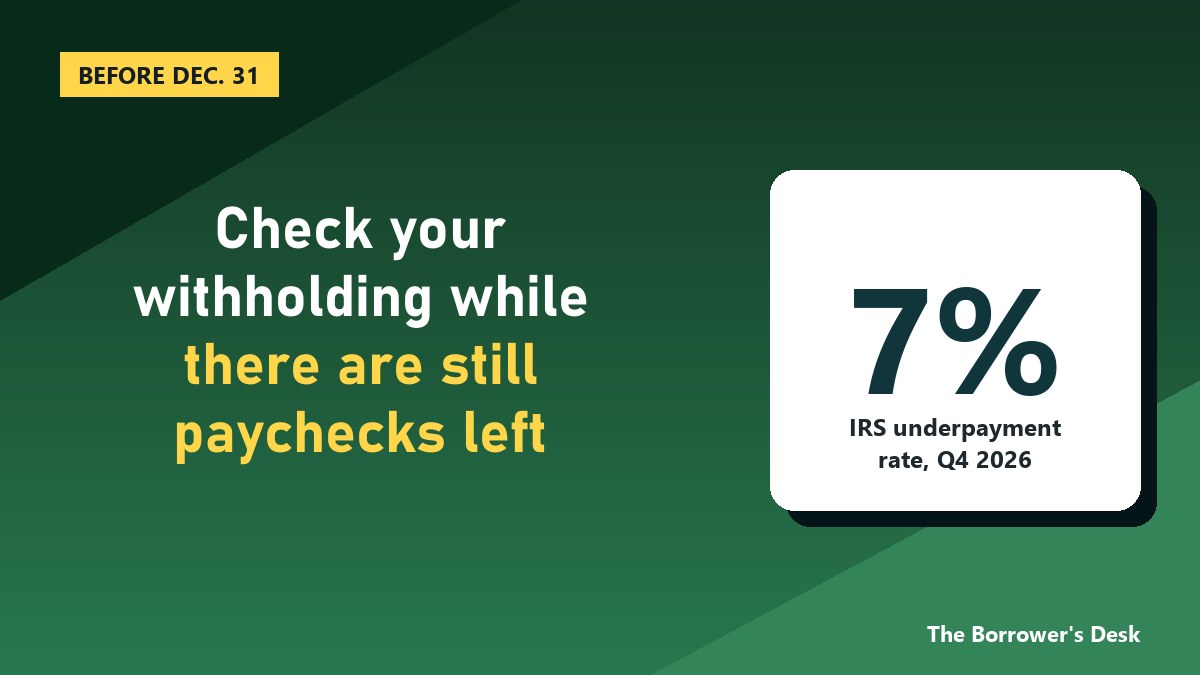
The penalty itself is interest. For the fourth quarter of 2026 the IRS rate is 7% a year, according to the IRS, charged on how much you were short and for how long.
Why withholding beats an estimated payment in December
This is the detail that makes a late fix work.
Estimated tax payments count on the date you make them. If you were short in April, June and September, a big payment in December doesn’t erase the penalty for those earlier quarters.
Withholding is different. The IRS treats it as paid evenly through the year unless you choose otherwise, even if most of it came out of your last few paychecks. So raising withholding in November and December can cover a shortfall from all of 2026.
That makes a W-4 change the better tool for anyone who has a paycheck.
How to change your W-4

Give your employer a new Form W-4. Most do it through the payroll portal. It usually takes effect within one or two pay periods, so do it this month.
The quickest fix for a shortfall is Step 4(c), extra withholding per pay period. Divide what you expect to owe by the paychecks left.
Say you have a side business and expect to owe $3,000 more than you’ve had withheld. If you’re paid every two weeks, about four paychecks remain after the change goes through. Enter $750 in Step 4(c). Each check gets $750 smaller, and you’ve covered it.
If you expect a big refund instead, Step 4(b) lets you enter deductions that will lower your tax. That’s where the new 2026 deductions for tips, overtime, car loan interest and the $6,000 senior deduction can go. With only a few checks left, though, the effect this year is small. It matters more for 2027.
Put a reminder on your calendar for early January. A $750 extra withholding meant for 2026 will keep coming out of every 2027 paycheck until you change it back.
If you don’t get a paycheck
Retirees, freelancers and people living on benefits have other options.
Social Security. You can have federal tax withheld from benefits by filing Form W-4V. The choices are 7%, 10%, 12% or 22%.
Pensions and IRA withdrawals. Use Form W-4P or W-4R with the payer. For IRA distributions you can ask for a larger amount withheld from a December withdrawal, and that withholding also counts as if paid evenly through the year.
Unemployment. You can request 10% withholding with Form W-4V through your state agency. Benefits are taxable at the federal level. Our guide on whether unemployment is taxed covers how much you might owe.
Self employed. The fourth quarter estimated payment for 2026 is due January 15, 2027. You can pay through IRS Direct Pay or your online IRS account. If a spouse has a paycheck, raising their withholding instead can do the same job and count for the whole year.
Big refund? That’s worth fixing too
A large refund isn’t free money. It’s your own pay that the government held all year without interest. The average refund runs in the thousands of dollars, which for a lot of households is a month or more of rent.
There’s not much to gain by cutting withholding for the last few checks of 2026. But if you got a large refund last spring and nothing has changed, update your W-4 in January. Spread across 26 paychecks, a $2,600 refund is $100 more in every check.
Questions people ask
Can my employer refuse a new W-4?
No. You can submit a new one at any time, and the employer has to put it into effect, usually by the start of the first payroll period ending 30 days after it gets the form.
Does changing my W-4 change my actual tax?
No. It only changes how much is paid in advance. Your actual tax is figured on your return.
What if I can’t pay what I owe in April?
File on time anyway. The penalty for not filing is much bigger than the penalty for not paying. The IRS offers payment plans online.
Does extra withholding from a bonus help?
Yes. You can ask payroll to withhold more from a bonus check, and that counts toward the year like any other withholding. Our bonus tax calculator shows what’s normally taken out.
Related reading
- Which 2026 Tax Moves Have to Happen by December 31?
- Tax Loss Harvesting Before December 31: How to Cut Your 2026 Tax Bill
- FSA Use It or Lose It: How to Spend Your 2026 Balance Before the Deadline
Tax figures are for the 2026 tax year. This article is general information, not tax advice. Use the IRS Tax Withholding Estimator or a tax professional for your situation. See our disclaimer.

Leave a Reply