Every December, parents and grandparents ask the same question before writing a big check: will this trigger gift tax? For almost everyone, the answer is no. The rules still matter, though, because a few of them reset on January 1 and a couple can cost money if you get them wrong.
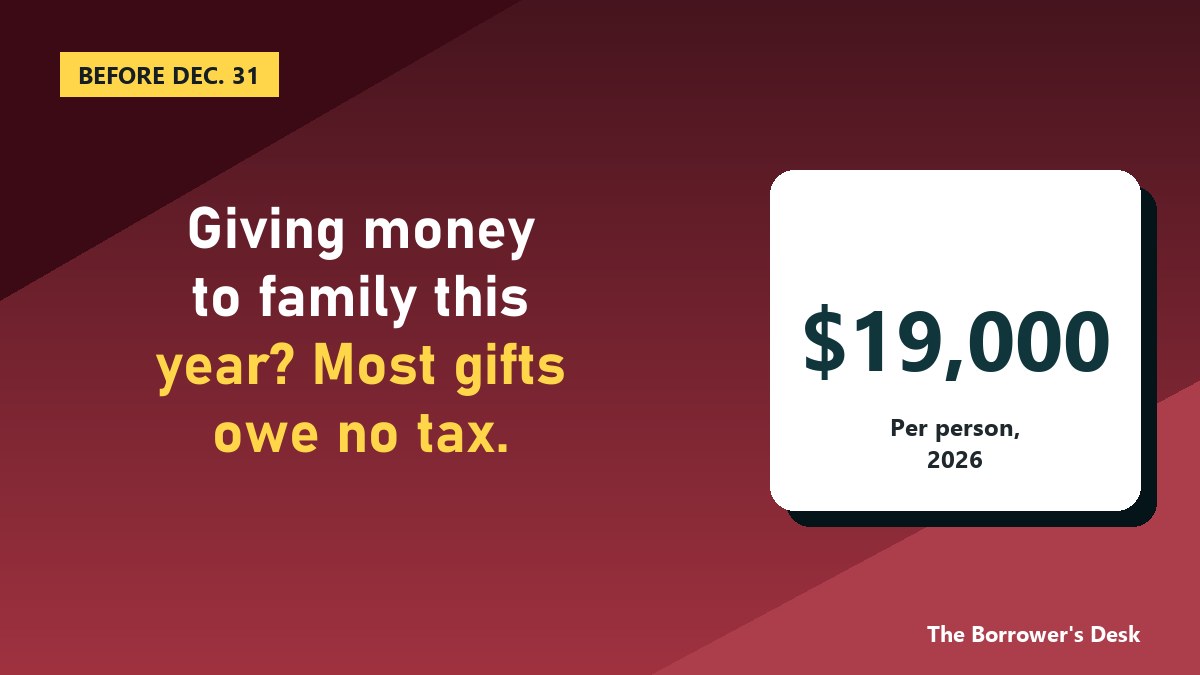
For 2026 you can give up to $19,000 to any one person without filing anything with the IRS. A married couple can give $38,000 to each person. There’s no limit on how many people you give to.
The $19,000 annual exclusion

The annual exclusion is per giver, per recipient, per year. It’s $19,000 for 2026, the same as 2025, under IRS Revenue Procedure 2025-32.
So one parent can give $19,000 to each of three children and $19,000 to each of four grandchildren. That’s $133,000 with no paperwork. Both parents together could give twice that.
The exclusion doesn’t roll over. If you give $5,000 this year, you don’t get to give $33,000 next year. That’s why the December 31 date matters. Any unused 2026 room disappears at midnight.
Going over $19,000 usually means a form, not a tax
If you give one person more than $19,000 in a year, you file Form 709, the gift tax return, by April 15, 2027. You almost certainly won’t pay anything.
The amount over $19,000 comes off your lifetime exemption, which is $15 million per person in 2026 under the 2025 tax law. Only after you’ve given away more than that over your whole life, counting what’s left at death, does any gift or estate tax come due.
Married couples who want to give a child $38,000 from one spouse’s account can “split” the gift. That works, but splitting itself requires filing Form 709, even when the total is under the limit.
Gifts that don’t count at all
Two kinds of payments don’t use the $19,000 exclusion or the lifetime exemption, no matter how large:
Tuition paid straight to a school. Write the check to the college, private school or preschool, not to the student. This covers tuition only. Books, dorm costs and meal plans don’t qualify for this unlimited treatment.
Medical bills paid straight to the provider. Hospital bills, surgery, dental work and health insurance premiums count, as long as you pay the provider or insurer directly.
A grandparent who pays a grandchild’s $30,000 tuition bill directly to the university can still give that grandchild $19,000 on top.
Make sure the gift is finished by December 31
A gift counts in the year it’s complete. For a check, that generally means the recipient deposits it and your bank pays it. A check written December 30 and cashed January 4 can end up counting as a 2027 gift.
If you’re giving near the limit, use a bank transfer or hand over the check early enough to clear. Gifts of stock count when the shares land in the recipient’s account, which can take several business days.
Cash, stock or a 529?

Cash is simplest. The recipient owes no income tax on a gift.
Stock is different. The recipient takes over your cost basis. If you bought shares for $2,000 that are now worth $19,000, the recipient owes tax on a $17,000 gain when they sell. That can still be a smart move if the recipient is in a low bracket, but it’s worth knowing. Shares that lost value are usually better sold by you first, so you can use the loss. Our article on tax loss harvesting before December 31 covers that.
Watch the kiddie tax with young children. Investment income above a small yearly threshold (it was $2,700 for 2025) for most children under 19, or under 24 if a full time student, can be taxed at the parents’ rate.
A 529 college savings plan has a special rule. You can put in up to five years of annual exclusions at once, $95,000 per child, or $190,000 from a married couple, and spread it over five years on Form 709. You can’t give that child more tax free gifts during those five years. Many states also give an income tax deduction for 529 contributions, and most require them by December 31 to count for the year.
Since 2026, 529 money can also pay up to $20,000 a year of K-12 tuition, up from $10,000.
When a gift can hurt
Medicaid. If you might need Medicaid for nursing home care, gifts made in the five years before applying can delay eligibility. That look back has nothing to do with the gift tax rules. A gift that’s fine for the IRS can still cause months of ineligibility. Our guide to Medicaid income limits has more on eligibility, and an elder law attorney can look at your situation.
Means tested benefits. A large cash gift to someone getting SSI can reduce or stop their payments for a month or more. For people on SSI, giving through an ABLE account or paying a bill directly often works better. See our SSI guide for the income and asset rules.
Your own retirement. Generous gifts feel good in December. They feel worse at 75 if the money was needed. Make sure your own savings are on track first.
Questions people ask
Does the person receiving the gift pay tax?
No. Gift tax, when it applies at all, is owed by the giver. The recipient doesn’t report a gift as income.
Can I give $19,000 to my child and $19,000 to their spouse?
Yes. Each person is a separate recipient. A couple can give $76,000 to a married child and spouse in 2026 without using any of their lifetime exemption.
Is money I give to a friend or neighbor treated the same way?
Yes. The exclusion has nothing to do with being related. It applies to any individual.
Do I need to file anything for gifts under $19,000?
No, unless you and your spouse split a gift or you made a five year 529 election.
Can I deduct a gift to family on my taxes?
No. Only gifts to qualified charities are deductible. Our guide on deducting charity without itemizing explains the new rules for 2026.
Related reading
- Which 2026 Tax Moves Have to Happen by December 31?
- Check Your W-4 Before December: How to Avoid a 2026 Tax Bill and Penalty
- Christmas Help for Low Income Families in 2026
Figures are for 2026. This article is general information, not tax or legal advice. Gifts involving Medicaid planning, trusts or large amounts are worth reviewing with a tax professional or attorney. See our disclaimer.

Leave a Reply