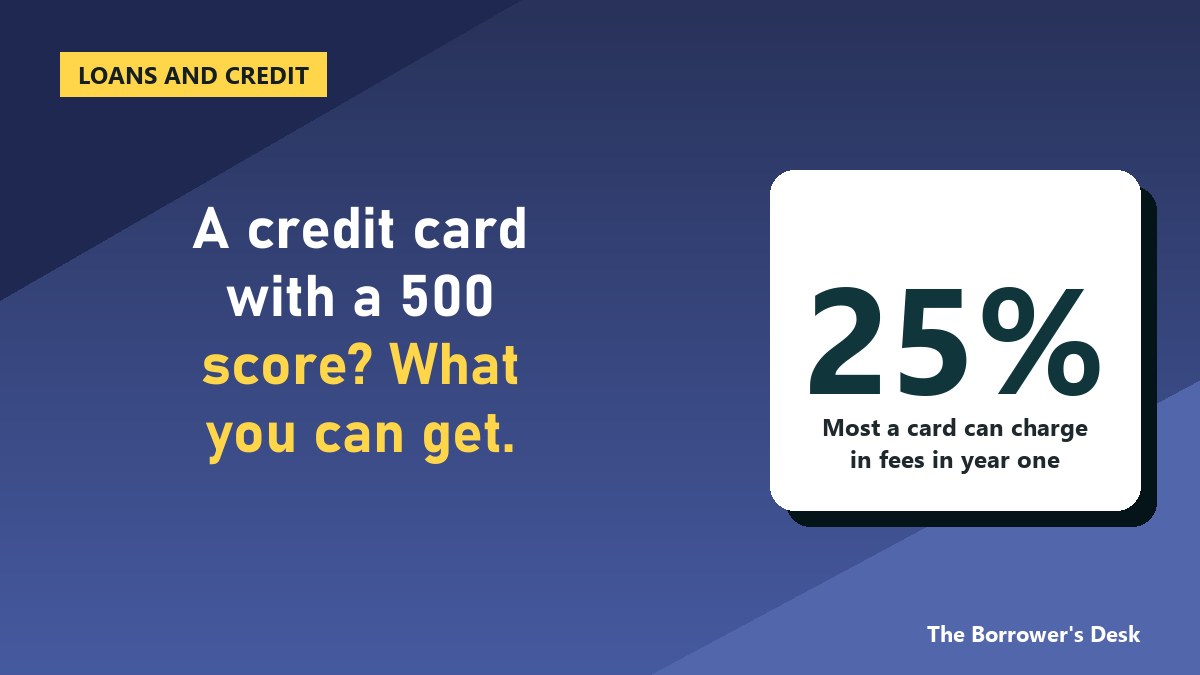
Yes, you can get a credit card with a 500 credit score. Most of the cards that will approve you fall into two groups: secured cards, where you put down a refundable deposit, and unsecured cards built for low scores, which skip the deposit but charge fees for it. The first group is usually the cheaper way back to a better score. The second can cost more in the first year than the credit line is worth.
This guide compares the routes side by side, shows the federal limit on what a low score card can charge you, and ends with a twelve month plan for moving up from 500.
What a 500 score tells a card issuer
FICO scores run from 300 to 850. A 500 sits well inside the range lenders call poor, which generally means anything under 580. At that level, most issuers assume something specific happened: payments 30 days or more late, an account in collections, a charge-off or a bankruptcy. Our guide to credit score ranges shows how lenders read each band.
The score is not the only thing that decides an application. Under the Credit CARD Act rules in 12 CFR 1026.51, an issuer has to consider your ability to make the required payments from your income or assets before it opens a card or raises the limit. If you are under 21, the income has to be your own, or you need a cosigner. So a steady paycheck, benefits income or a spouse’s income you can reasonably access all count, and a low score with income is a different application from a low score without it.
The three routes, compared

1. A secured card from a large issuer
You put down a deposit, and the deposit backs your credit line. Because the issuer is protected, several of the large banks do not require a minimum score at all. Two examples, from the issuers’ own pages as of November 18, 2026:
- Capital One Platinum Secured. No annual fee and no credit score required to apply. The minimum refundable deposit is $49, $99 or $200, depending on your credit, and you have 35 days after approval to pay it. You can deposit more for a higher line. The purchase APR is listed at 29.24% variable.
- Discover it Secured Cash Back. No annual fee and no credit score required to apply. A deposit as low as $49 opens a credit line of at least $200, and it earns cash back like Discover’s regular card. Discover says it reviews accounts for an upgrade to its unsecured card once you build a positive track record.
The deposit is not a fee. You get it back when you close the account in good standing or when the issuer moves you to an unsecured card. What it costs you is the use of that money for a year or so.
Two things can still get you turned down for a secured card: a bankruptcy that has not been discharged, and problems with a bank account in the past, since many issuers check the deposit account you pay from.
2. A no deposit credit builder card
A newer kind of card links to a checking account at the same company and lets you spend only what you move onto it. Chime Card is one example. Chime says there is no credit check to apply, no annual fee, no interest and no minimum security deposit, and that it reports to the major credit bureaus. You must open a Chime Checking Account to get it.
Because you cannot borrow beyond what you moved over, these cards cannot run up interest. They also have no real credit line, so they do less for the part of your score based on how much of your available credit you use. They work best for someone who wants on time payments on the report without any chance of new debt.
3. An unsecured card for poor credit
This is the group most people mean when they search for a $500 limit card with no deposit. These cards approve low scores without a deposit, and they make up for the risk with fees: an annual fee, sometimes a monthly maintenance fee, and in some cases a one time program fee charged before the account opens.
Federal law puts a ceiling on this. Under 12 CFR 1026.52(a), the total fees you are required to pay in the first year cannot be more than 25% of the credit limit you had when the account opened. Late fees, over the limit fees and returned payment fees are left out of that cap.
What the 25% cap allows on a typical low limit card:
| Starting credit limit | Most required fees in year one |
|---|---|
| $300 | $75 |
| $500 | $125 |
| $700 | $175 |
| $1,000 | $250 |
So on a $500 limit card that charges the maximum, $125 of the line can be taken up by fees, and if those fees sit on the balance, you pay interest on them too. After the first year the cap no longer applies, and the annual fee can stay the same.
Compare that to the Capital One example above. On a $200 line with a $49 deposit, you pay nothing in fees, and the $49 comes back. Even a $200 deposit for a $200 line is money you recover, while $125 of fees is gone.
Which route fits your situation

Most people with a 500 score fit one of these four cases.
You have a few hundred dollars you can set aside. A secured card from a large issuer is the strongest choice. It has no annual fee, reports like a normal card and gives you a path to an unsecured upgrade with the same company.
You have very little cash, but you do have direct deposit income. A credit builder card like Chime’s gets payment history onto your report without a deposit or a credit check. Some secured card issuers also accept a $49 deposit as the minimum for applicants they rate better, so it is worth checking a large issuer’s prequalification tool first. Our guide to personal loan prequalification explains why those checks do not affect your score.
You were recently denied a secured card. Look at the reason in the denial letter before you apply anywhere else. An open bankruptcy, an unpaid balance with the same issuer or a closed bank account in your past are fixable problems, and another application before you fix them adds another hard inquiry. Our guide to reading a denial letter walks through the common reasons.
You want credit history without any card. A credit builder loan from a credit union or bank reports monthly payments to the bureaus, and you get the money at the end. Our guide to credit builder loans covers what they cost. A share secured loan against your own savings works the same way.
How to use the card once you have it
The card itself does little. What raises the score is the record you build on it. Payment history and the share of your credit line you use are the two largest parts of a FICO score, and a new card affects both.
- Pay on time every month. One payment 30 days late resets much of the progress. Set up an automatic payment for at least the minimum the day the card arrives.
- Keep the reported balance low. The balance on your statement is the one that usually gets reported. On a $200 line, a $150 statement balance shows 75% use, even if you pay it in full a week later. Paying part of the balance before the statement closes keeps the reported figure low.
- Pay the statement balance in full when you can. At a 29.24% APR, carrying a balance is expensive. A $500 balance paid down at $25 a month takes 28 months to clear and costs about $194 in interest, close to 40% of the original balance. Our credit card interest guide shows how the daily balance is figured. To run your own numbers, try our credit card payoff calculator.
- Do not open several cards at once. Each application can mean a hard inquiry, and several new accounts at once lower the average age of your credit.
A twelve month plan from 500
None of these steps needs a paid service.
Month 1. Pull your free reports at AnnualCreditReport.com. Dispute anything wrong. Look for collections you do not recognize and late payments that were not late. Our guide to removing collections has the letters.
Month 1 or 2. Open one card, using the routes above. If your landlord or a rent reporting service can report your payments, add that too. Our guide to whether paying rent builds credit covers which services report to which bureau.
Months 2 to 6. Use the card for one small regular charge, such as a phone bill, and pay it off each month. Give it time. Capital One says more than 2.4 million of its secured card customers since 2016 saw their score rise at or after the seventh month with responsible use.
Months 7 to 12. Ask the issuer about an upgrade or a higher line, and look at your score again. If you still have collections or charge-offs, focus on the newest ones, since recent problems weigh more than old ones. Our guide to raising a score by 100 points covers what tends to move it fastest.
When you do qualify for an unsecured card, think twice before closing the secured one. Closing it returns the deposit but can shorten your history and raise your utilization. Our guide to closing a credit card explains when it helps and when it hurts.
The short version
With a 500 score, a secured card from a large issuer is usually the best first card: no annual fee, no score requirement, a deposit you get back and a path to an upgrade. A credit builder card tied to a checking account is the no deposit option that cannot run up debt. Unsecured cards for poor credit approve without a deposit, but federal rules let them take up to 25% of your credit limit in fees in the first year, so a $500 limit can come with $125 of fees. Whatever you choose, on time payments and a low statement balance are what lift the score.
Card terms are from the Capital One, Discover and Chime websites as of November 18, 2026, and change often, so read the issuer’s rate and fee disclosure before you apply. Fee and ability to pay rules are from 12 CFR 1026.51 and 1026.52. This is general information, not financial advice, and this site does not receive payment from any card issuer named here.
Official sources: 12 CFR 1026.51, ability to pay, 12 CFR 1026.52, limits on fees, AnnualCreditReport.com.

Leave a Reply