The Weatherization Assistance Program pays a local crew to make a low income home cheaper to heat and cool: insulation, air sealing, and repairs or replacement of an unsafe or failing heating system when the energy audit supports it. You pay nothing, and nothing has to be repaid. A household qualifies with income at or below 200% of the federal poverty level, which for 2026 is $31,920 a year for one person and $66,000 for a family of four, or if someone in the home received SSI or TANF cash in the past 12 months.
The catch is that this is not a check, and it is not fast. Each state runs its own program through local agencies, homes are served in priority order, and many areas have a waiting list. That is why the best time to apply is now, before the coldest months, even if the work is not done until spring.
The income test, in numbers

Federal rules in 10 CFR 440.22 make a home eligible in one of three ways:
1. Income at or below 200% of the poverty guidelines. 2. A household member received cash assistance under Title IV or XVI of the Social Security Act, which means TANF or SSI, at any time in the 12 months before the eligibility decision. 3. The household qualifies for LIHEAP, if the state chooses to use that rule, as long as the state’s LIHEAP line is at least 200% of poverty.
Here is the 200% line for 2026 in the 48 states and DC:
| Household size | Yearly income at 200% | Monthly |
|---|---|---|
| 1 | $31,920 | $2,660 |
| 2 | $43,280 | $3,607 |
| 3 | $54,640 | $4,553 |
| 4 | $66,000 | $5,500 |
| 5 | $77,360 | $6,447 |
| 6 | $88,720 | $7,393 |
Add $11,360 a year for each person after six. Alaska and Hawaii use higher guidelines, so their lines are higher too. Our post on the 2026 federal poverty level has the full tables, and our poverty level calculator shows where your own income falls.
Most agencies look at the last 30 days or the last 12 months of income for everyone in the home. Take a retired couple living on $3,900 a month in Social Security. That is over the $3,607 line for two. If a grandchild lives with them, they are a household of three, and the line becomes $4,553, so they qualify. A state that uses a higher LIHEAP line could also let the couple in on its own.
Who goes first
Meeting the income test gets you on the list. Your place on it depends on priority. The same federal rules tell states to put these households first:
- People who are elderly
- People with disabilities
- Families with children
- High residential energy users
- Households with a high energy burden, which means a large share of income goes to energy bills
A household that checks several of these boxes, such as a grandparent raising children in a drafty house with large heating bills, will usually move faster than a single working adult with modest bills. Ask the agency how its list works and roughly how long the wait is in your county. The answer differs a great deal from one place to the next.
What happens after you apply

The program follows the same basic steps everywhere, though the timing is local.
Step 1: The application. You apply through your state’s weatherization office or the local agency it funds, often a Community Action Agency. The Department of Energy’s how to apply page has a map with links to each state. Expect to show proof of income for everyone in the home, proof that you own the home or have the landlord’s written permission, and recent utility bills.
Step 2: The energy audit. A trained auditor visits and tests the home. This usually includes a blower door test, which uses a fan to measure how much air leaks out of the house, plus a check of the furnace or boiler, the water heater and any gas appliances for safety problems such as carbon monoxide.
Step 3: The work order. The audit decides what gets done. Federal rules require measures to pay for themselves in energy savings over their life, so the crew does the improvements that save the most for the money first. Health and safety fixes needed to do the work safely can be added.
Step 4: The work. A crew or contractor installs the measures. Common ones are attic and wall insulation, sealing gaps around doors, windows, pipes and ducts, and repair or replacement of a heating system that is unsafe or failing. Window replacement is less common because it rarely pays for itself.
Step 5: The final inspection. Federal rules require a final inspection of the finished work, including any furnace or other mechanical work, before the job is counted as complete.
How much a home can get
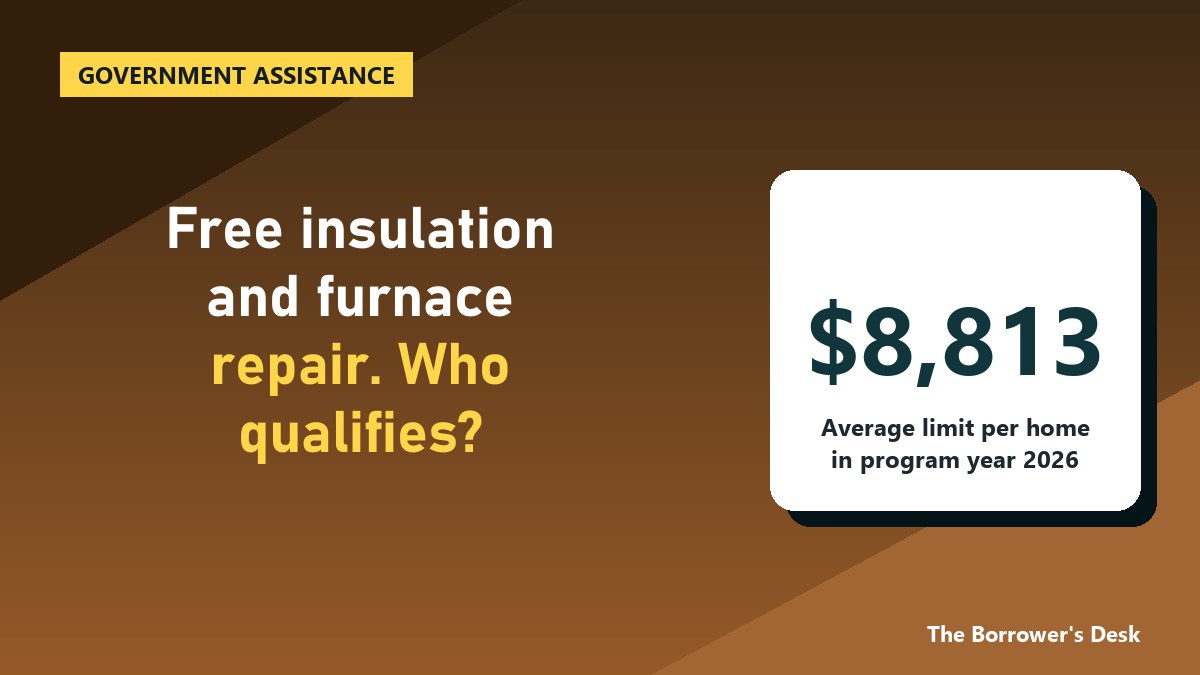
There is no fixed amount per house. The limit is an average across all homes the state weatherizes in a year. For program year 2026, the Department of Energy’s Weatherization Program Notice 26-1 sets that average at $8,813 per home. One house may get much more than that and another much less, depending on what the audit finds.
What it saves is the bigger number for most families. The Department of Energy says households save $372 or more a year on average, based on a national evaluation of the program. Insulation and air sealing keep paying off for as long as you live there.
When the work is put on hold
Some homes are turned down for now, which the program calls a deferral. The usual reasons are problems that make it unsafe or pointless to insulate: a leaking roof, mold, standing water, serious structural damage, pests or asbestos. Insulating over a roof leak, for example, would trap water in the attic.
A deferral is not a final no. Fix the problem and reapply. Since 2022, Congress has funded a separate Weatherization Readiness Fund so that agencies can pay for some of these repairs and then go ahead with the work, and many local agencies also work with home repair programs that can fix a roof first. Ask the agency what it would take to lift the deferral and whether it can help pay for it.
Renters can qualify
The program is not limited to owners. Under 10 CFR 440.22(b), an agency can weatherize a rental unit with the written permission of the owner or the owner’s agent. In buildings with more units, at least 66% of the units generally have to be eligible, or 50% in duplexes, four unit buildings and some larger multifamily buildings.
The rules also protect the tenant. States must have procedures so the benefit goes mainly to the low income renters, and so rent is not raised for a reasonable period because of the work. If your landlord is reluctant, it can help to point out that the improvements cost the owner nothing and raise the value of the unit. Some states may ask landlords of larger buildings to share part of the cost.
If your home was weatherized before
A home weatherized through the program can be done again once 15 years have passed since the earlier work was completed. That rule comes from 42 U.S.C. 6865, as changed by the 2021 infrastructure law. If you bought or rented a house and are not sure of its history, the agency can check its records.
How this fits with LIHEAP
The two programs work together, and a household that qualifies for one often qualifies for the other.
| LIHEAP | Weatherization | |
|---|---|---|
| What it pays | Part of the energy bill | Repairs that lower future bills |
| How it is paid | To the utility or fuel company | To the crew doing the work |
| Federal income line | Up to 150% of poverty, or 60% of state median income | 200% of poverty |
| Speed | Crisis help in 48 hours | Weeks to months |
LIHEAP itself can also pay for weatherization. Federal law lets a state use up to 15% of its LIHEAP money for low cost weatherization and energy related home repair, or up to 25% with a federal waiver. In some states that money flows to the same local agencies.
If you have a bill due now or a shutoff notice, apply for LIHEAP first. Our guide to how much LIHEAP pays explains the amounts and the crisis rules, and our list of winter shutoff protection by state shows which states block disconnections in cold months. Then apply for weatherization so next winter’s bills are smaller.
Before you call
A short checklist makes the first call faster:
- Total household income for the last 30 days, with pay stubs, benefit letters or bank statements for each adult.
- Your last few heating and electric bills, which also help show a high energy burden.
- A deed or mortgage statement, or your lease and the landlord’s contact information.
- A list of known problems: a furnace that keeps failing, rooms that will not stay warm, roof leaks, moisture in the basement.
Weatherization is free, and no legitimate agency will ask you for a fee to apply or to move up the list. If a company calls offering free government insulation and asks for your bank details or a deposit, hang up and contact your state weatherization office directly.
The rules here are federal. States set their own waiting lists, documents and some measures, so confirm the details with your state’s program. For other help that uses the same income lines, see our guide to 2026 relief programs for unemployed Americans.
Official sources: Department of Energy: Weatherization Assistance Program, DOE: how to apply for weatherization assistance, 10 CFR 440.22, eligible dwelling units, 10 CFR 440.16, priority households, Weatherization Program Notice 26-1, 42 U.S.C. 6865, limits on assistance, HHS poverty guidelines.

Leave a Reply