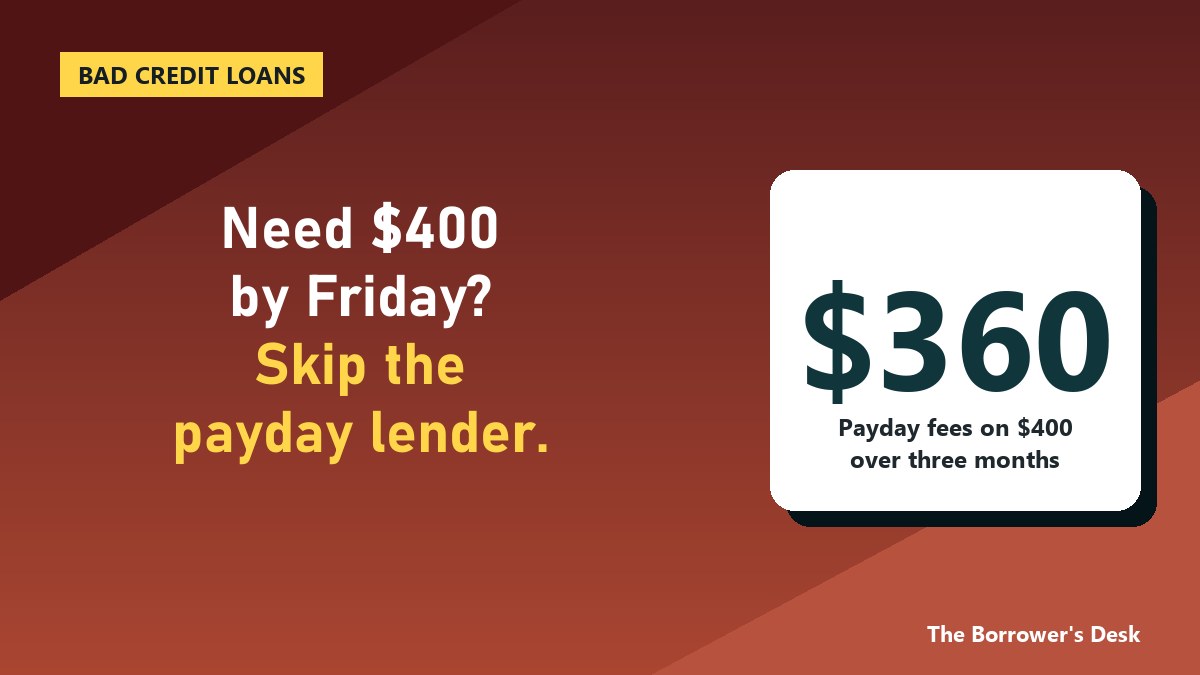
Borrow $400 from a payday lender at the common fee of $15 per $100, renew it five times because the full balance never fits in one paycheck, and you will have paid $360 in fees and still owe the $400. Borrow the same $400 from a federal credit union through a Payday Alternative Loan and pay it back over three months, and the interest comes to about $19, plus an application fee of no more than $20.
That gap is not a teaser rate or a promotion. It is federal law. The National Credit Union Administration caps the interest rate on these loans at 28%, the fee at $20, and the term at up to 12 months. Payday loans at $15 per $100 work out to an annual percentage rate of almost 400%, according to the Consumer Financial Protection Bureau.
The catch is that most people who need $400 by Friday have never heard of a PAL, and many credit unions do not advertise them. This guide shows the math, what the rules allow, where the limits are and how to ask for one.
How a $400 payday loan turns into $760
A payday loan is usually due in full on your next payday, about two weeks out. The CFPB says fees range from $10 to $30 per $100 borrowed, depending on state law, and $15 is typical. On $400, that is $60 for two weeks.
The trouble starts when the $460 does not fit in one paycheck. Most lenders let you pay the $60 fee and renew, and the $400 rolls over for another two weeks. The CFPB reports that almost 70% of payday borrowers take a second loan within a month.
| Two week periods | Fees paid so far | Still owed |
|---|---|---|
| 1 | $60 | $400 |
| 3 | $180 | $400 |
| 6 | $360 | $400 |
| 10 | $600 | $400 |
After six periods, about three months, the borrower has handed over $760 for $400 of cash. That is the same three months a PAL would have spread the loan across.
What a Payday Alternative Loan is

Federal credit unions can make two kinds of small loans under 12 CFR 701.21(c)(7), and both are written to replace payday loans:
| Rule | PAL I | PAL II |
|---|---|---|
| Amount | $200 to $1,000 | Up to $2,000 |
| Term | 1 to 6 months | 1 to 12 months |
| Membership first | At least 1 month | No waiting period required |
| Maximum rate | 28% APR | 28% APR |
| Application fee | Up to $20, actual cost | Up to $20, actual cost |
Both are repaid in equal installments that pay the loan down to zero. There is no balloon payment at the end and no rollover. A credit union may not make more than one PAL to you at a time or more than three in any six month period, and it cannot roll one PAL into another.
The credit union is supposed to look at your ability to repay, but it does not need to use a credit score cutoff, and many look mainly at your income and your history with them. PAL II was added in 2019 so new members could borrow right away instead of waiting a month.
The numbers side by side
Here is the same $400 borrowed for about three months:
- Payday loan renewed five times: $360 in fees, then the $400. Total $760.
- PAL I over three months at 28%: three payments of about $139.60. Interest about $19. With a $20 fee the total is about $439.
On $1,000 over six months, a PAL costs about $83 in interest. A payday lender charging $15 per $100 would collect $150 every two weeks on the same balance, or $1,950 in fees over six months of renewals.
Some PALs carry a lower rate than 28%. That is the ceiling, not the price.
The twist: why you may not see one offered

PALs are optional. A credit union does not have to offer them, and many of those that do make few of them each year. The loans are small and the rate is capped, so they do not earn much, and some credit unions offer them mainly to members they already know.
Three things work against first time borrowers:
1. You have to be a member. Joining usually takes a small deposit, often $5 to $25, and you must qualify by where you live, work or worship, or through an association that anyone can join. Many credit unions accept online applications. 2. The PAL I one month wait. If the credit union only offers PAL I, you must be a member for a month first. Join before you need the money. 3. The name varies. Credit unions call these loans by their own names, such as a small dollar loan, a quick cash loan or an emergency loan. Ask whether the loan is made under the NCUA payday alternative loan rule, and you will get a straight answer.
State chartered credit unions are not covered by the PAL rule, though many have their own small loan programs with similar terms.
If a PAL is not available
- Ask the creditor first. Utilities, landlords and medical offices often accept a payment plan for the bill you were going to borrow for. A plan costs nothing.
- Earned wage access through your employer. Some employers let you take pay you have already earned before payday. Check the fees, which can add up if you use it every pay period.
- A credit card cash advance. Costly, often around 25% to 30% APR plus a fee of about 5%, but still far below a payday loan for a short period.
- Military members are covered by the Military Lending Act, which caps the military annual percentage rate on most consumer loans at 36%.
- Help that is not a loan. If the problem is rent, heat or food, the programs in our guide to relief for unemployed Americans do not have to be repaid.
How to get one this week
1. Find a federal credit union near you with the NCUA credit union locator, and check who it serves. 2. Call and ask directly: “Do you offer PAL I or PAL II loans, and how soon can a new member apply?” 3. Bring proof of income, such as two recent pay stubs, a benefits letter or bank statements showing deposits. 4. Pick the shortest term you can afford. At 28%, each extra month adds interest, though far less than a renewal fee. 5. Set up automatic payment from your account at the credit union so you do not miss an installment.
On time payments are reported to the credit bureaus by many credit unions, which can help a thin or damaged credit file. If building credit is the goal, see our guide to the best credit builder loans, and our list of hardship loans for the unemployed covers more options when you have no paycheck. To compare the cost of your own offer, use our payday loan cost calculator.
The bottom line
A payday loan is priced for two weeks and built to be renewed. A Payday Alternative Loan is priced at no more than 28% a year and built to be paid off. On a $400 emergency, that difference is roughly $760 against $439. The work is in finding a credit union that offers one and joining before you need it, which is why the best time to ask is now.
Official sources: 12 CFR 701.21, loans to members, including payday alternative loans, NCUA final rule on PALs II, 2019, CFPB, costs and fees of a payday loan, CFPB, why the APR on a payday loan is so high, NCUA credit union locator, Military Lending Act, 32 CFR 232.

Leave a Reply