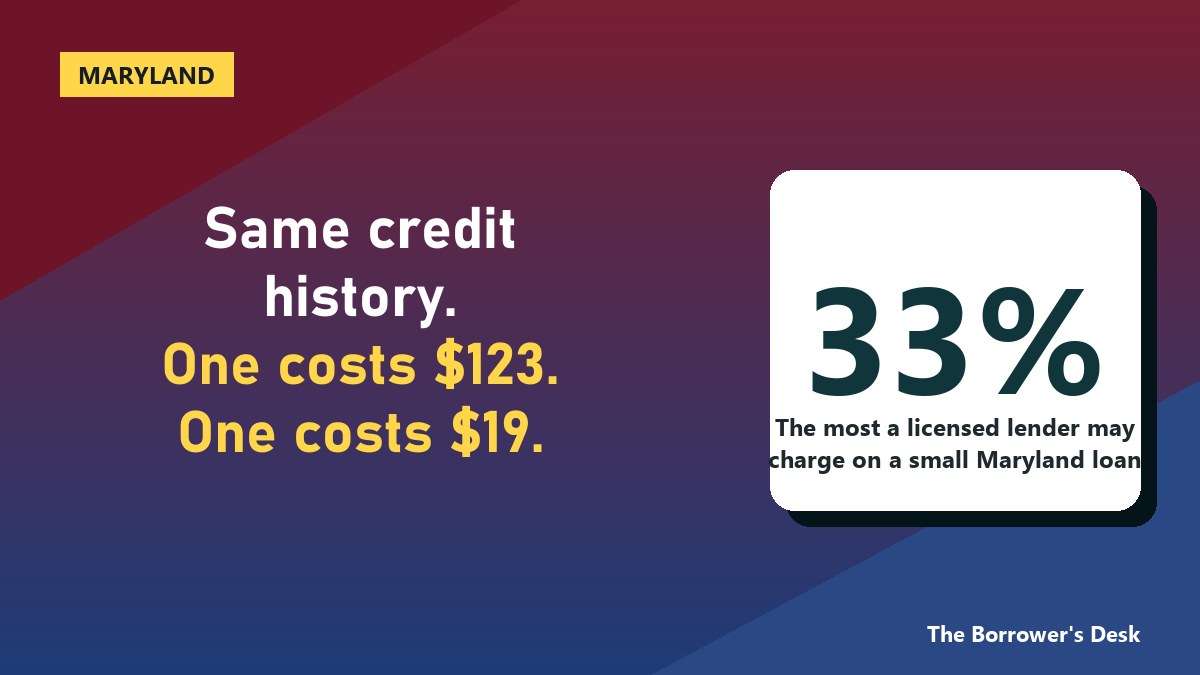
A Maryland borrower can pay $123 to build two years of credit history, or about $19. The $123 is the finance charge on a popular online credit builder account at $35 a month. The $19 is the interest on a share secured loan of the same size at a Maryland credit union charging 2.55% APR. On a credit report, the two look alike: an installment loan, paid on time.
Maryland adds a twist most states do not have. Its Consumer Loan Law caps the interest a licensed lender may charge at 33% a year or less, and a loan from a lender without the right license may not be enforceable at all. Before you sign up for anything sold as a credit builder loan here, it helps to know which rules protect you and which ones stop at the state line.
What a credit builder loan means in Maryland
There is no single Maryland product with that name. Two different loans are sold for the same job.
The first is the locked loan. The lender sets the money aside, you make monthly payments, and you receive the cash at the end. You need no savings to start. Most of these are sold online.
The second is the share secured loan, sometimes called a savings secured loan. You already have money in a credit union savings account. The credit union holds that money as collateral and lends you the same amount. Because the credit union cannot lose money on the loan, the rate is very low.
Both are installment loans, and both can put on time payments on your credit report. The difference is who puts up the cash on day one.

What Maryland credit unions charge
These are the terms each credit union published on its own website as of November 27, 2026. Rates move, so confirm before you apply.
Cedar Point Federal Credit Union. Its personal loans page lists a share secured loan at an APR as low as 2.55% for terms up to 60 months, which it describes as 2.5% over its published share rate. The payment is $17.79 a month per $1,000 borrowed. An 84 month term is listed at 3.55%. The page notes that minimum loan amounts apply.
APGFCU. Its rate sheet, effective November 26, 2026, lists the “My Money” share secured loan at 3% above the regular share rate, with an APR as low as 3.20%. The credit union has branches in Aberdeen, Bel Air, Edgewood, Elkton, Havre de Grace and other towns in the northeast part of the state.
Lafayette Federal Credit Union. It uses the name itself. Its personal loans page lists a Credit Builder Loan of up to $5,000 with terms up to 7 years, and a separate Share Secured Loan up to your savings balance with terms up to 15 years. The rate table, effective November 1, 2026, ties both rates to the dividend rate on your savings, so ask for the exact APR on the day you apply.
For comparison, the online Self Credit Builder Account at the $35 plan shows a 15.69% APR on its pricing page. You pay $35 a month for 24 months, $840 in total, and receive $717 at the end. The finance charge is $123.
Run the same $717 over the same 24 months at Cedar Point’s 2.55% and the payment is about $30.68 a month. Total interest comes to roughly $19.20. At APGFCU’s 3.20% it is about $24.14. Your pledged savings keep earning dividends the whole time.
The catch: the cheap loan needs cash you already have
A share secured loan at 2.55% only works if the money is already in your savings account. The loan is a loan against your own deposit. While a balance remains, the pledged part of your savings is not yours to spend.
Many people who search for a credit builder loan do not have $700 set aside. That is why the $123 version exists. It asks for no deposit. You are paying about $100 extra for the lender to front money you do not have yet.
There is a middle path. The loan does not have to be large to count. A $300 loan paid on time for 12 months creates the same kind of installment record as a $1,000 one, and at 2.55% it costs about $4.16 in interest. A $500 loan for 12 months costs about $6.93. Ask the credit union what its minimum loan is, since some set one. If you can put together a few hundred dollars from a tax refund or a few paychecks, the credit union route opens up.

What Maryland law caps
Maryland does not allow the triple digit rates seen in many other states. Under the Maryland Consumer Loan Law, Commercial Law section 12-306, a licensed lender may charge:
- On a loan of $2,000 or less: 2.75% a month on the part of the unpaid balance up to $1,000, and 2% a month on the part above $1,000. That is 33% and 24% a year.
- On a loan of more than $2,000: 2% a month on the unpaid balance, or 24% a year.
The same section bars the lender from charging interest in advance or compounding it. It also limits how long the loan can run: about 30 months for a loan of $700 or less, and about 36 months for a loan above $700 but below $2,000.
Federal credit unions answer to a lower ceiling. The NCUA has kept the maximum rate on most federal credit union loans at 18%, and its February 2026 letter extended that ceiling through September 10, 2027.
Those caps are ceilings, not prices. A $500 loan for 12 months at the full 33% would cost about $93.81 in interest. At the 18% federal credit union ceiling it would cost about $50.08. At 2.55% it costs $6.93. The credit report entry is the same in all three cases.
The license rule that protects you
Maryland requires a consumer loan license for a business that makes loans under the Consumer Loan Law. The Office of Financial Regulation states that a consumer loan acquired by an unlicensed person is unenforceable under the Financial Institutions Article, section 11-219(b).
In practice, that gives you a simple check. Before you hand over bank details, search the lender’s name on NMLS Consumer Access, the free public database that Maryland uses for its licenses. A real lender shows up with a Maryland license. If you cannot find it, ask the Office of Financial Regulation before you sign.
What the caps do not cover
Two gaps matter for credit builder products.
First, the cap is on interest. Some apps charge a monthly membership or subscription on top of interest, or in place of it. A $5 monthly fee on a $500 loan adds $60 over a year, more than the interest at 18%. Ask for the total of all payments and the amount you get back. The gap between those two numbers is the real price. Our credit builder loan calculator does that math for any offer.
Second, banks and credit unions are not licensed under the Consumer Loan Law, and many online accounts are issued through banks chartered in other states. Read the loan agreement to see who the lender is. The name on the app is not always the name on the contract.
Who should skip this loan
A credit builder loan is not a fit for everyone. The Consumer Financial Protection Bureau funded a study of 1,531 credit union members who were offered one. People with no existing debt were 24% more likely to end up with a credit score. People who already had debt saw their scores slip by about 3 points on average. And 39% of everyone who opened the loan paid late at least once.
A late payment on a loan you took only to build credit does the opposite of what you paid for. If your budget is already tight, a new monthly bill is a risk. Our longer guide to how credit builder loans work and who they help walks through that study.
If what you need is cash for an emergency and not a credit history, look at payday alternative loans from credit unions, which are capped at 28%. Live in the Gulf South? We ran the same comparison for credit builder loans in Louisiana.
What to do this week
- Pick a credit union you can join. Membership usually depends on where you live, work or worship, so check the membership page first.
- Ask for the share secured loan by that name. Staff may not call it a credit builder loan.
- Ask four questions: what is the APR today, is there a minimum loan amount, are there any fees, and do you report to all three credit bureaus.
- Keep the loan small and the term at 12 to 24 months. Set up automatic payments from the day you sign.
- If you have no savings, compare the total cost of an online plan with the option of saving $300 first.
- Look up any lender that is not a bank or credit union on NMLS Consumer Access before you apply.
Deposits at federally insured credit unions are insured up to $250,000, so the savings you pledge are protected while they sit there.
Official sources: Maryland Commercial Law section 12-306, maximum interest rates, Maryland Office of Financial Regulation, consumer lenders, NMLS Consumer Access, NCUA letter 26-FCU-02, 18% interest rate ceiling extended, CFPB, Targeting credit builder loans, NCUA share insurance coverage. Lender terms: Cedar Point Federal Credit Union personal loans, APGFCU personal loan rates, Lafayette Federal Credit Union personal loans, Self pricing.

Leave a Reply