Plenty of applicants with a decent credit score get declined over a number they never calculated. If you earn $6,000 a month before taxes and $2,100 already goes to rent, a car loan and card minimums, your debt-to-income ratio (DTI) is 35%, and every lender will add the new loan’s payment on top before deciding.
The math is monthly debt payments divided by gross monthly income, the same definition the Consumer Financial Protection Bureau uses. A strong score can’t fully make up for a ratio that’s too high, because DTI answers a different question for the lender, whether one more payment fits in your month.
Working out the number
Take the $6,000 earner above. Divide the $2,100 in payments by $6,000 and you get 0.35. Multiply by 100 for 35%. Now add a $300 personal loan payment and it’s $2,400 over $6,000, or 40%. That second number is the one the lender sees.

Payments that usually count include rent or your mortgage payment including property tax and insurance, car loans and leases, student loans, minimum payments on credit cards, personal loans, and child support or alimony. Utilities, phone bills, groceries and insurance that isn’t part of the housing payment usually don’t count.
Use the gross figure from your pay stub, before taxes and deductions. Running the math on take-home pay makes the ratio look worse than the lender’s figure, and leaving out the new payment makes it look better.
The debts lenders count that you might not
Mortgage underwriting is where the counting rules are written down, and Fannie Mae’s guide on monthly debt obligations has three that catch people.
Deferred student loans still count. If your loans are in deferment or forbearance, the lender can use a payment equal to 1% of the outstanding balance. On $40,000 of student debt that’s $400 a month added to your DTI, even though you’re paying nothing today. The exception is an income-driven plan where the lender can document that your actual payment is $0.
A card with no minimum payment showing on your credit report gets one assigned. Without documentation of a lower payment, the lender has to use 5% of the balance, so a $3,000 balance becomes a $150 monthly payment in the calculation.
And an installment loan that’s nearly done can drop out. Debts with ten or fewer monthly payments left generally aren’t counted, unless the payment is big enough to affect your ability to pay your other bills. If your car loan has 11 payments left, making one extra payment before you apply can take the whole payment out of the math. Personal loan lenders set their own rules, so ask, but it’s worth knowing the mortgage version exists.
What income lenders will count
The bottom of the fraction matters as much as the top, and lenders count only income they can verify and expect to continue. Salary and hourly pay are usually checked with recent pay stubs and W-2s. Self-employment income usually comes from tax returns, after business expenses, often averaged over two years. Bonuses, overtime and commission tend to count only with a history of receiving them. Rental income, benefits, pensions and support payments count when they’re documented and likely to keep coming.
Self-employed borrowers get caught here all the time. Every deduction that lowered your tax bill also lowered the income a lender sees, which pushes your DTI up.
How high is too high?
There’s no single cutoff. Each lender and loan program sets its own, but a few reference points come up over and over.

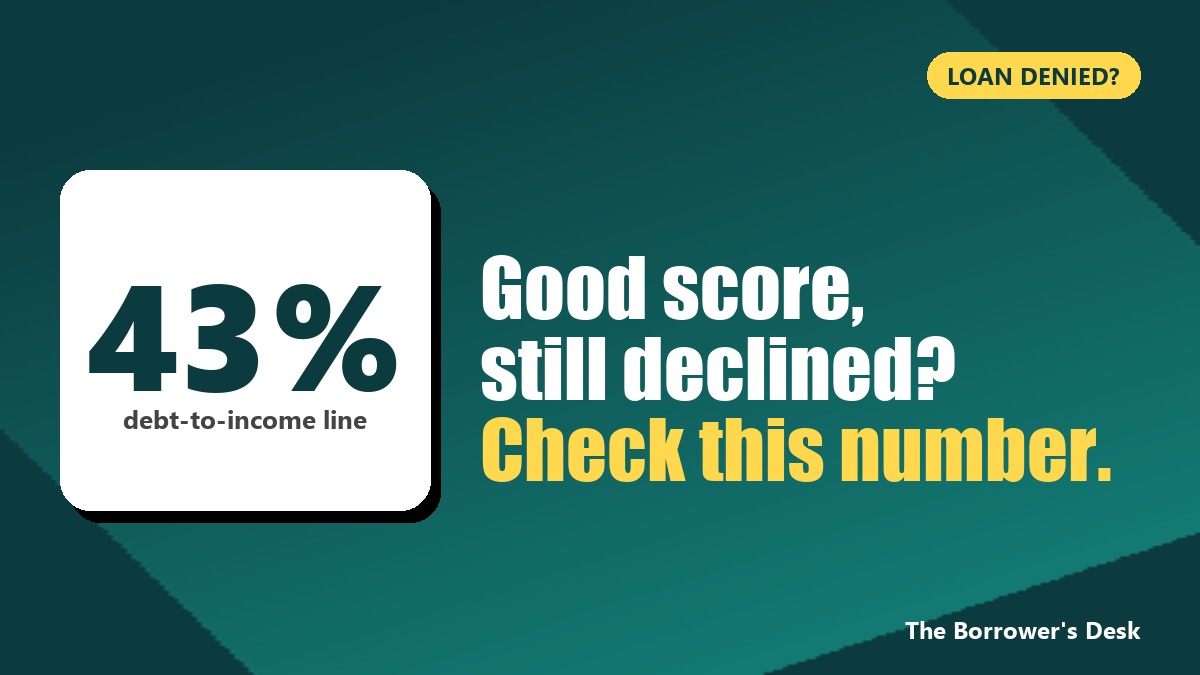
Around 36% is comfortable territory for most lenders. Around 43% is a long-standing mortgage benchmark. It was a hard cap in the federal Qualified Mortgage rule, until a 2021 revision replaced it with a pricing test, but plenty of lenders still treat 43% as a line. At the top end, Fannie Mae’s guide, as of 2026, allows up to 50% for loans run through its automated underwriting system. Manually underwritten loans max out at 36%, or 45% if the borrower meets the credit score and reserve requirements.
Personal loan lenders are usually stricter, because nothing secures the loan. Many prefer a DTI under roughly 36% to 40% including the new payment. If you’re near the top of any of these ranges, expect a higher rate or a smaller approval rather than a clean yes.
Front-end and back-end ratios

Mortgage lenders often look at two versions. The front-end ratio counts housing costs only. The back-end ratio counts every monthly debt, housing included, and it’s the one most lenders mean when they say DTI without qualifying it.
Two applicants, one loan
A credit score looks back at how you’ve handled debt, while DTI measures the room in your budget right now. Picture two people applying for the same $15,000 personal loan with a $400 monthly payment, both earning $5,000 a month.
Applicant A has a 780 score and $2,300 in existing payments. Add the $400 and it’s $2,700 out of $5,000, a 54% DTI. Applicant B has a 670 score and $1,100 in existing payments. With the new loan that’s $1,500 out of $5,000, or 30%.
Plenty of lenders would decline A and approve B, probably at a higher rate for B. A has the cleaner history and the tighter month, and one more payment could push that budget past what it can carry.
Lowering it before you apply

The fastest move is usually to clear a small balance completely. Paying off a $900 card removes its entire minimum payment from the calculation. The same $900 sent to a $20,000 car loan barely changes that loan’s payment. Once the zero balance is reported, usually within a billing cycle or two, your DTI drops.
Documenting income you already have can help as much as cutting debt. Side income, bonuses and rental income can count if you can show a steady history, often two years of it. Refinancing a high payment to a longer term lowers the monthly figure lenders use, though it can raise the total interest you pay. Adding a co-borrower brings their income into the calculation, and their debts too, so run both before you ask.
While you work on it, don’t open new credit. A new account adds a payment and a hard inquiry at the same time.
Check your own ratio first
Pull your latest credit report and write down every monthly payment on it, plus rent or your housing payment. Add the payment for the loan you want. Check for deferred student loans and cards with no listed minimum, and add the amounts a lender would assign them. Divide by gross monthly income.
Under 36%, DTI probably isn’t your problem. Between 36% and 43%, expect lenders to look harder at the rest of the file. Above that, it’s usually faster to remove one payment than to wait for a raise, and a few weeks of paying down the right account can change the answer.
DTI doesn’t appear on your credit report, because the report doesn’t include income, so lenders calculate it from your application. It doesn’t affect your credit score directly either, although the balances and payments behind it do.
Related reading
- Your Loan Was Denied. What the Letter Tells You and What to Do Next
- Self-Employed? How Lenders Will Read Your Income
- How Much House Can I Afford on a $75,000 Salary?
The Fannie Mae limits quoted here come from its Selling Guide as of 2026 and apply to conventional mortgages. Personal loan and auto lenders set their own, so ask the lender which debts it counts and what ratio it allows.

Leave a Reply