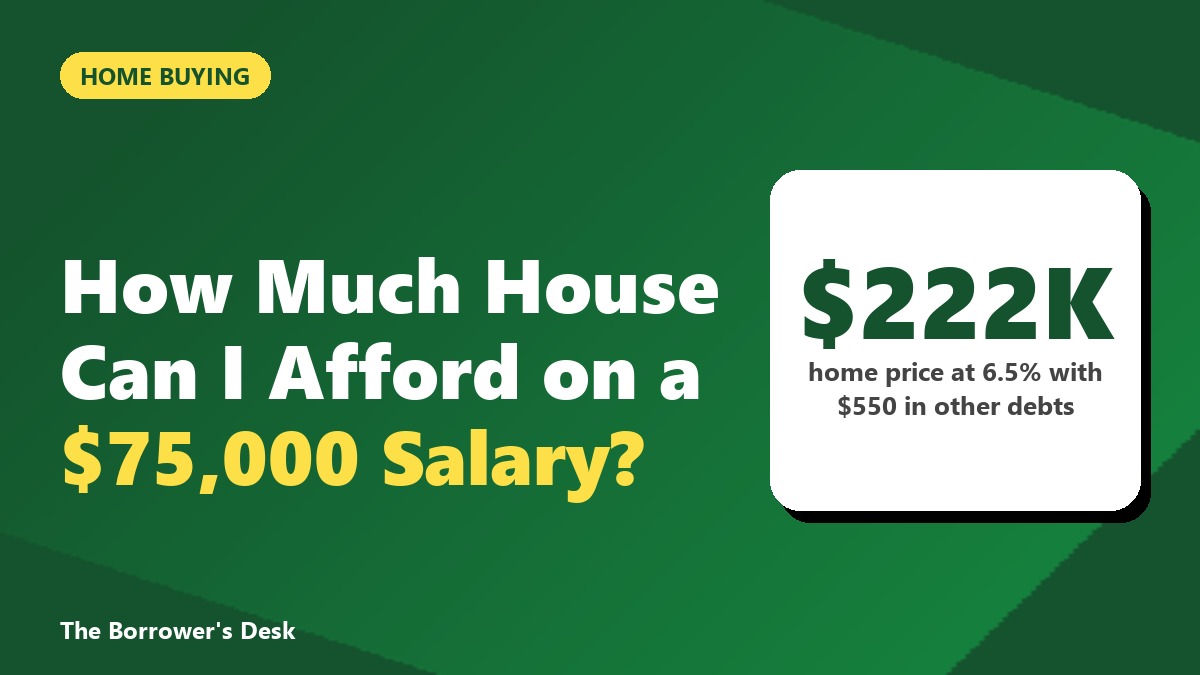
On $75,000 a year, a typical buyer ends up looking at homes priced somewhere around $205,000 to $270,000. The salary only sets the frame. Car and student loan payments, the size of the down payment, the mortgage rate and the county’s property tax rate decide where in that range you land.
Lenders start from gross pay, which is $6,250 a month at this salary, and run it through two ratios before deciding how big a mortgage you can carry.
The 28/36 rule lenders start with
The traditional guideline has two parts. Your total housing payment should stay at or below 28% of gross monthly income. That payment includes principal, interest, property tax, homeowners insurance, and mortgage insurance if you have it. All of your monthly debt payments together, housing included, should stay at or below 36% of gross income. That second figure is what the CFPB calls your debt-to-income ratio: all monthly debt payments divided by gross monthly income.
At $6,250 a month, 28% is $1,750 and 36% is $2,250. Whichever limit is lower sets your ceiling.
Many loan programs allow more. Fannie Mae’s guidelines, for example, permit a total debt-to-income ratio up to 45% with manual underwriting when the file has compensating factors, and up to 50% on loans approved through its automated system. FHA loans, which lenders underwrite to HUD’s Single Family Housing Policy Handbook, can also stretch past 36%. A lender approving you at 45% tells you what the lender will accept, which may be more than your monthly budget can comfortably absorb.
A worked example on $75,000
The buyer in this example is made up, with figures chosen to look like a common first purchase:
- Gross income of $75,000, or $6,250 a month.
- A $400 car payment and a $150 student loan payment, $550 a month in other debt.
- A 30-year fixed mortgage at 6.5%.
- Property tax of 1.1% of the home’s price per year.
- Homeowners insurance of $1,800 a year, or $150 a month.
- A 10% down payment, with private mortgage insurance (PMI) at 0.5% of the loan per year.
The 28% test allows $1,750 for housing. The 36% test allows $2,250 for all debt, and after the $550 in other payments only $1,700 is left for housing. So the 36% limit is the one that binds, and the housing budget is $1,700 a month.
Working backward from $1,700, the price that fits is about $222,000. On a $222,054 home, the payment breaks down like this:
- Loan amount after 10% down: $199,849.
- Principal and interest at 6.5% over 30 years: $1,263.18.
- Property tax: $203.55.
- PMI: $83.27.
- Insurance: $150.00.
- Total: $1,700.00 a month.
The down payment would be about $22,205, before closing costs.

What changes the number most
Other debt. Without the $550 in car and student loan payments, the 28% limit of $1,750 would bind instead, and the same buyer could afford about $229,000 with 10% down. Every $100 of monthly debt you clear frees up roughly $100 of housing budget under the 36% test.
Down payment. Putting 20% down removes PMI and shrinks the loan. With less down, the CFPB explains that you can ask to remove PMI once your balance reaches 80% of the home’s original value. With $550 in other debts, the price that fits $1,700 rises to about $259,000, and with no other debts to about $268,000. You need the cash for it, though. Twenty percent of $259,000 is about $51,900, more than twice the 10% down payment.
The rate. Holding the $1,700 budget and 10% down fixed, each half point moves the price by roughly $8,500 to $10,500. At 5.5% the buyer could afford about $242,000. At 7.5% the figure drops to about $204,000.

Property tax and insurance. These can vary several times over from one county to the next. A home in an area with a 2% property tax rate would cost about $370 a month in tax at $222,000, compared with $203.55 in the example, and the affordable price would fall accordingly. Insurance premiums have also climbed sharply in some states. Get a local estimate for both before you settle on a price range.
Approved versus comfortable
The 28/36 rule uses gross pay, but bills come out of take-home pay. Depending on state taxes, retirement contributions and health insurance, take-home pay at $75,000 often lands somewhere between about $4,300 and $4,900 a month. A $1,700 housing payment is roughly 35% to 40% of that.
Homeownership also carries costs the mortgage payment leaves out: repairs, maintenance, utilities that may run higher than in an apartment, and HOA dues in some communities. A common planning figure for upkeep is 1% of the home’s value per year, which is about $185 a month on a $222,000 house.
Two quick checks help. First, add up your current rent plus whatever you save each month. If that total is well below the projected housing payment plus upkeep, the new payment will squeeze your budget. Second, look at your emergency savings after the down payment and closing costs. Draining it to zero to buy the house leaves no room for the first broken water heater.
Cash you need beyond the down payment
- Closing costs, often a few percent of the loan amount, for lender fees, title insurance, appraisal and prepaid items.
- Escrow deposits for the first months of property tax and insurance.
- Moving and setup costs, which buyers tend to underestimate.
- Reserves. Some lenders want to see a few months of mortgage payments left in savings after closing.
The Consumer Financial Protection Bureau has free tools for estimating these costs and comparing loan offers in its Owning a Home section. A HUD-approved housing counselor can also walk through your budget and loan options, often for free.
How to run your own number
- Divide your annual salary by 12 for gross monthly income.
- Multiply by 0.28. Then multiply by 0.36 and subtract your current monthly debt payments. Use the smaller result as your housing budget.
- Subtract estimated insurance and, if you will put down less than 20%, PMI.
- Get a local property tax rate and a current mortgage rate quote, then use a mortgage calculator to find the price whose payment fits the budget.
- Compare that price with what your take-home pay and savings can carry, and use the lower of the two.
Related reading
- Debt-to-Income Ratio: The Number Behind Many Loan Declines
- Which Mortgage Lenders Approve First-Time Buyers
- Hard vs Soft Credit Inquiries: How Many Applications Is Too Many?
The buyer, rate and tax figures above are illustrations. Your lender’s preapproval, a local tax estimate and an insurance quote will give the real numbers for your purchase.

Leave a Reply