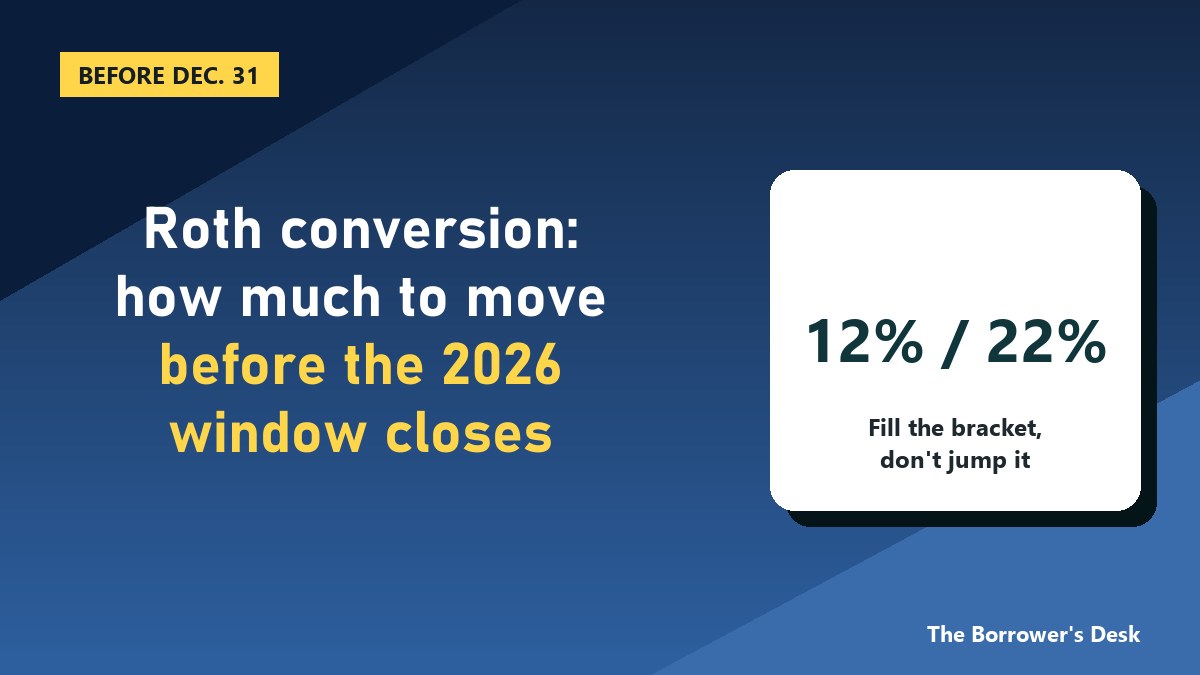
A Roth conversion counts for 2026 only if the money leaves your traditional IRA or 401(k) and lands in a Roth by December 31. There’s no extension and no April grace period like there is for IRA contributions. Since 2018 there’s also no way to undo a conversion once it’s done.
That makes the next seven weeks the time to decide. You’ll know most of your 2026 income by now, which is what you need to pick an amount.
What a Roth conversion does
You move money from a pre tax account, like a traditional IRA, into a Roth IRA. The amount you move is added to your taxable income for the year. In exchange, that money and everything it earns afterward can come out tax free in retirement, as long as you follow the Roth rules.
You don’t need to be under an income limit to convert. Anyone with a traditional IRA or an old 401(k) can do it.
The bet is simple. You pay tax now because you expect your rate later to be the same or higher. If your rate in retirement will be lower, converting usually costs you money.
Fill the bracket, don’t jump it

The most common approach is to convert just enough to reach the top of your current tax bracket. Above that point, each extra dollar is taxed at a higher rate.
For 2026, the 12% bracket ends at $50,400 of taxable income for single filers and $100,800 for married couples filing jointly. The 22% bracket ends at $105,700 and $211,400. The 24% bracket ends at $201,775 and $403,550. These figures come from IRS Revenue Procedure 2025-32.
Taxable income is after the standard deduction, which is $16,100 for single filers and $32,200 for married couples in 2026, plus extra for people 65 and older.
Take a married couple expecting $120,000 of taxable income for 2026. They are in the 22% bracket, with $91,400 of room before 24% starts. Converting up to $91,400 costs about $20,100 in federal tax. Converting $120,000 would push $28,600 into the 24% bracket.
Your exact room depends on your full return. Pull up last year’s return and your latest pay stubs, or ask your tax preparer for a projection.
Years when converting makes the most sense
Some years are cheaper than others for a conversion:
- The years between retiring and starting Social Security or required distributions, when income is low
- A year with a job loss, a sabbatical or a business loss
- A year when the account value has dropped, so the same number of shares costs less tax to move
- Before a surviving spouse has to switch to single filing, which has narrower brackets
If you retired early and are living on savings, you may have thousands of dollars of room in the 10% and 12% brackets that will never be this cheap again.
Costs that don’t show up in the bracket table

A conversion raises your adjusted gross income, and a higher AGI can cost money in other places.
Medicare premiums. Income above set levels raises Part B and Part D premiums through a surcharge called IRMAA. Medicare looks back two years, so 2026 income sets 2028 premiums. For 2026 premiums, the first surcharge tier started at $109,000 for single filers and $218,000 for joint filers. One dollar over a tier triggers the full surcharge for that tier.
The senior deduction. People 65 and older can take an extra $6,000 deduction for 2026, but it shrinks once modified AGI passes $75,000 single or $150,000 joint. A conversion can reduce or erase it. Our article on the $6,000 senior deduction has the phase out math.
ACA premium credits. If you buy health insurance on the marketplace, a conversion raises the income used to figure your premium credit. See our guide to ACA premium tax credit income limits before converting.
Social Security taxes. Extra income can make more of your Social Security benefit taxable.
State tax. Most states tax conversions like other income. Moving to a state without income tax next year might be a reason to wait.
Pay the tax from outside the account
The conversion works best if you pay the tax with money from a savings or brokerage account. If you have tax withheld from the conversion itself, less money reaches the Roth. If you’re under 59½, the withheld amount also counts as an early distribution and can carry a 10% penalty.
Plan how you’ll pay. Tax on a December conversion counts for 2026, so it can create an underpayment penalty if nothing else covers it. Our underpayment penalty calculator shows if your payments so far are enough. Raising withholding from your last paychecks is one fix, and our guide to checking your W-4 walks through it.
Rules that trip people up
Take your required distribution first. If you’re old enough for required minimum distributions, the 2026 RMD has to come out before you convert, and the RMD itself can’t be converted. Our RMD guide covers the deadlines.
The five year rule. Each conversion has its own five year clock. If you’re under 59½ and withdraw converted money within five years, the 10% penalty can apply even though you already paid income tax on it.
The pro rata rule. If you have both pre tax and after tax money across your traditional IRAs, you can’t convert only the after tax part. The IRS treats each conversion as a mix based on all your IRA balances on December 31.
Start early in December. Some custodians need several business days, and many get busy at year end. Ask your custodian when the last date is to submit a request that will finish in 2026.
Questions people ask
Can I convert part of my IRA?
Yes. You can convert any amount, and many people convert a set amount each year to spread out the tax.
Is there a limit on how much I can convert?
No. The annual Roth contribution limit doesn’t apply to conversions.
Can I convert a 401(k) at my current job?
Many plans allow an in plan Roth conversion. Ask your plan administrator. For a 401(k) from an old job, you can usually roll it to an IRA first and then convert.
What if the market drops right after I convert?
You can’t undo it. You’ll have paid tax on a higher value. Some people split a conversion into pieces across the year for that reason.
Does a conversion count as a contribution?
No. It doesn’t use up your annual Roth IRA contribution, which is $7,500 for 2026, or $8,600 if you’re 50 or older. Our article on contributing to a Roth IRA and a 401(k) in the same year has the income limits for contributions.
Related reading
- Which 2026 Tax Moves Have to Happen by December 31?
- Tax Loss Harvesting Before December 31: How to Cut Your 2026 Tax Bill
- Social Security at 62 vs. 67
Figures are for the 2026 tax year. This article is general information, not tax advice. Conversions can affect Medicare premiums, health insurance credits and state taxes, so check your full picture with a tax professional. See our disclaimer.

Leave a Reply