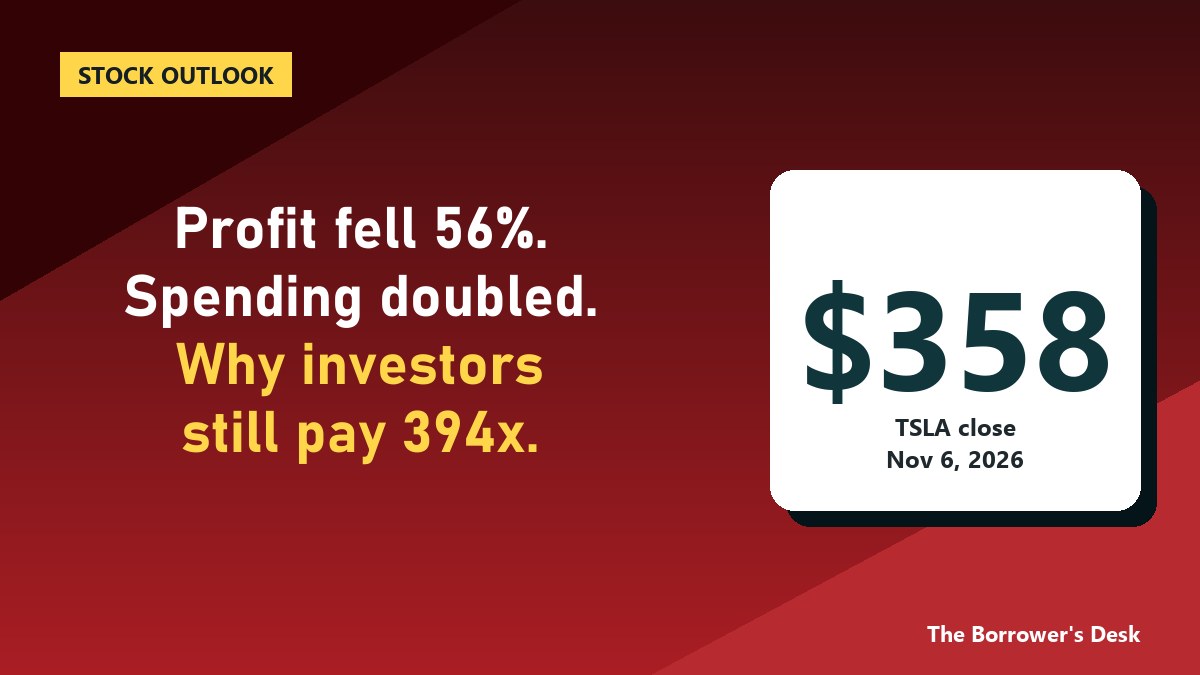
Tesla stock lost 10.8% on November 5, its worst day in months, and closed at $343.69. It got some of that back on November 6, rising 4.2% to $358.20. That still leaves the shares about 27% below their record close of $489.88 from December 16, 2025.
The selloff didn’t come from a Tesla announcement. It came two days after the midterm elections, during a broad drop in AI and chip stocks, and while investors are still trying to price a possible merger with SpaceX. Underneath all of that sits a business that earned very little in the September quarter while spending more than ever.
Below are the third quarter numbers, what the valuation looks like at $358 and what analysts expect.
Tesla’s September quarter

Tesla reported revenue of $28.05 billion for the quarter, about flat with a year earlier, according to its quarterly filing.
The pieces moved in different directions. Automotive revenue was $20.56 billion. Energy generation and storage fell about 16% to $2.88 billion, even though Tesla deployed 13.7 gigawatt hours of storage, up 10%. Services and other revenue, which includes charging, insurance, used cars and parts, grew about 33% to $4.61 billion and posted record gross profit.
Deliveries were 486,532 vehicles, down about 2% from a year ago but above what analysts expected. Production was 464,391, so Tesla sold more cars than it built and cut inventory.
There was real progress on margins. Total gross margin rose to 19.6% from 18.0%. Automotive gross margin without regulatory credits rose to 18.1% from 15.4%. That matters, because credit sales to other automakers fell to $113 million from $417 million and won’t carry results the way they used to.
Where the profit went
Operating income was $718 million, down 56% from $1.62 billion a year earlier. The operating margin was 2.6%.
The reason is spending. Operating expenses rose 39% to $4.78 billion. Research and development alone grew 69% to $2.76 billion, driven by AI training, the Optimus humanoid robot and self driving work. Stock based compensation was $1.17 billion, up from $663 million.
GAAP net income was $787 million, or $0.22 a share. Adjusted earnings were $0.48 a share, close to last year’s $0.50.
Spending and cash

Capital spending was $4.73 billion in the quarter, more than double the $2.25 billion a year earlier. Through nine months Tesla has spent about $13.0 billion, and its full year plan is well above $20 billion.
Free cash flow came in at $1.53 billion, down from $3.99 billion. That’s still positive, which separates Tesla from Meta, whose free cash flow went negative this quarter.
Tesla ended September with $45.4 billion in cash and investments. It can fund the build out for a long time without borrowing heavily or selling stock.
Robotaxi and FSD
Most of the value investors assign to Tesla rests on autonomy, so these numbers get as much attention as car sales.
Full Self Driving had about 1.74 million active subscriptions at the end of the quarter, up 67%. That count includes people who bought the software outright.
The Robotaxi service in Austin had logged nearly 2 million cumulative unsupervised miles by the end of September, about eight times the figure three months earlier. Rides in the Cybercab, the two seat vehicle with no steering wheel or pedals, began in Austin on September 3.
Those are early numbers. Tesla hasn’t broken out Robotaxi revenue, and the service is still small next to the size of the bet.
The SpaceX question
Around October 20, Tesla and SpaceX each set up special committees of independent directors to study a possible combination. Elon Musk, who runs both, called a merger a good idea but said it isn’t certain and that he’s stepping aside from the talks.
No terms have been announced. Tesla’s annual meeting is set for December 3, and the proxy for it doesn’t include a merger vote.
Approval would be harder on the Tesla side. Musk controls more than half of SpaceX’s voting power, but a Tesla merger would need a majority of all Tesla shares outstanding, not just those that vote. Big holders who worry about dilution could block it.
After the midterms, analyst Dan Ives said a merger now faces a harder path. Market coverage of the November 5 drop also pointed to worries that Democratic control of Congress could mean more scrutiny for Musk’s companies and for data center expansion.
Is Tesla stock expensive at $358?
At the November 6 close, Tesla was worth about $1.42 trillion.
The trailing price to earnings ratio is close to 394, and the forward ratio about 168. For comparison, Meta trades at about 18 times expected earnings, Alphabet near 20 and Amazon close to 27.
That gap shows how little of Tesla’s price is explained by today’s profit. Operating income over the last four quarters is about $3.5 billion. In 2022 it was $13.7 billion. Buyers at $358 are paying mainly for Robotaxi, Optimus and energy storage turning into large businesses.
Tesla pays no dividend.
What analysts expect from TSLA
The average 12 month price target from 44 analysts tracked by StockAnalysis is $413.10, about 15% above the November 6 close. The median is $436. The range is unusually wide, from $128 to $600.
Recent notes after the October report:
- Cantor Fitzgerald: buy, $485
- RBC Capital: buy, $480
- Bank of America: buy, $460
- Deutsche Bank: buy, $420
- Evercore ISI: hold, $300
A spread from $128 to $600 for the same company says analysts don’t agree on what Tesla is. Some value it as a carmaker with an energy business. Others value it as an AI and robotics company that happens to sell cars.
What could move Tesla from here
Fourth quarter deliveries come out in early January. A return to growth would help the car business story, and a further drop would hurt it.
Any formal step on SpaceX, such as named advisers or proposed terms, would likely move the stock sharply either way.
Robotaxi expansion beyond Austin is the next test. A new city with unsupervised rides, and any disclosure of what the service earns, would matter more than another quarter of mileage numbers.
The 2027 spending plan should come with fourth quarter results in late January. Investors will compare it with the AI budgets at Microsoft, Alphabet and Amazon.
Questions people ask about Tesla stock
Why did Tesla stock drop on November 5?
Tesla didn’t release bad news that day. The 10.8% fall came during a broad selloff in AI stocks after the midterm elections, with added worry about regulation of Musk’s businesses and the path for a SpaceX merger.
Does Tesla pay a dividend?
No. Tesla has never paid a dividend and puts its cash into factories, AI computing and new products.
Is Tesla still growing?
Revenue was flat and deliveries fell about 2% in the September quarter. Energy storage deployments and services revenue grew. Most of the growth investors are betting on hasn’t shown up in revenue yet.
What happens to my shares if Tesla and SpaceX merge?
No deal exists yet. If one is proposed, Tesla shareholders would vote on it, and the terms would say how many shares of the combined company each Tesla share becomes.
Should I sell Tesla at a loss for taxes?
If you hold Tesla in a taxable account below what you paid, selling before December 31 can let you use the loss against other gains. Our guide to tax loss harvesting explains the wash sale rule if you plan to buy back in.
Related reading
- Meta Stock Forecast: Ads Grew 26%, So Why Is META 22% Below Its High?
- AWS Grew 39%. Why Amazon Stock Fell on Earnings and Then Jumped 6%
- Capital Gains Tax on Stocks in the USA
Prices are from the November 6, 2026 close and change every trading day. This article is general information, not a recommendation to buy or sell any stock. Check the latest filings and talk to a licensed adviser before you invest. See our disclaimer.

Leave a Reply