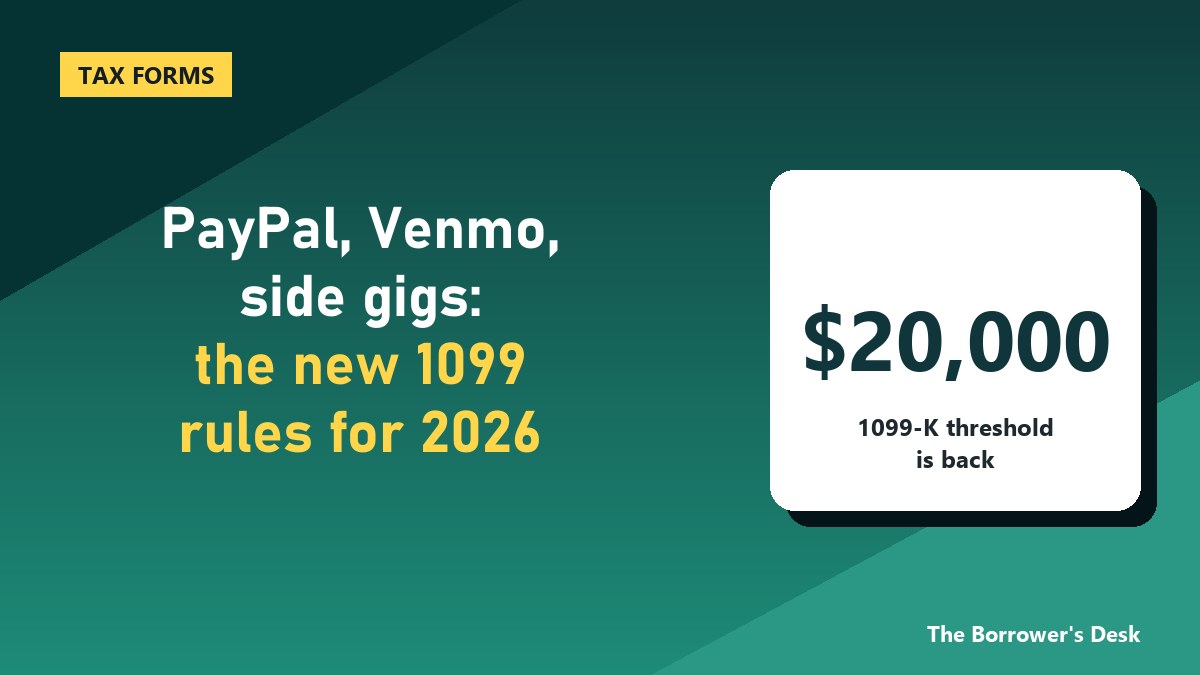
If you sold things on eBay, took payments through PayPal or Venmo for a side gig, or did freelance work this year, the rules on which tax forms you get for 2026 are not what you may have heard. Two changes in the 2025 tax law raised the reporting thresholds, and one of them was made retroactive.
The short version: a payment app or online marketplace sends a Form 1099-K for 2026 only if you received more than $20,000 in more than 200 transactions. A business that paid you for services sends a Form 1099-NEC only if it paid you $2,000 or more, up from $600. Neither change makes any income tax free. They only change who gets a form.
Here is what to expect in January and February 2027, and what to do before December 31 so your records are ready.
Form 1099-K: back to $20,000 and 200 transactions

Form 1099-K reports payments you received through payment card networks and through third party settlement organizations, the IRS term for payment apps and online marketplaces such as PayPal, Venmo, Cash App, eBay and Etsy.
For years the threshold was more than $20,000 and more than 200 transactions. A 2021 law cut it to $600, and the IRS spent several years phasing that in: $5,000 for 2024, $2,500 planned for 2025, then $600.
Section 70432 of the 2025 law undid all of that. It restored the old threshold as if the 2021 change had never been made. The IRS confirmed in its fact sheet FS-2025-08 that the $20,000 and 200 transaction test applies again, so a payment app has to send you a 1099-K for 2026 only when both tests are met.
Three details trip people up:
- Card payments have no threshold. If you run a business that takes credit or debit cards directly through a card processor, you can get a 1099-K for any amount. The $20,000 test applies only to payment apps and marketplaces.
- A platform can still send a form below the threshold. The IRS says some platforms will send one anyway, and a few states set lower thresholds for their own reporting.
- Friends and family payments are not reportable. Money for splitting dinner, rent shared with a roommate or a birthday gift should not appear on a 1099-K. Tag those payments correctly in the app when you send or receive them.
Form 1099-NEC and 1099-MISC: $600 becomes $2,000
Section 70433 of the same law raised the threshold for Form 1099-NEC and Form 1099-MISC from $600 to $2,000 for payments made after December 31, 2025. That means 2026 is the first year it applies. Starting with 2027, the $2,000 figure will be adjusted for inflation.
If you freelance, a client who paid you $1,500 in 2026 does not have to send you a 1099-NEC. You still report that $1,500. If you run a small business and hire contractors, you only need to file 1099-NEC forms for people you paid $2,000 or more during 2026.
A few amounts did not change. Royalties are still reported at $10, and payments to attorneys still have a $600 threshold. Interest and dividends still show up on Form 1099-INT and 1099-DIV at $10 or more.
When the forms arrive

The usual deadlines for sending forms to you are January 31 and February 15. When a deadline falls on a weekend or federal holiday, it moves to the next business day. In 2027:
- January 31 is a Sunday, so Forms 1099-K, 1099-NEC, 1099-MISC, 1099-INT and 1099-DIV are due to recipients by Monday, February 1, 2027
- February 15 is Presidents Day, so Form 1099-B and the consolidated statements most brokers send are due by Tuesday, February 16, 2027
If you plan to file early, wait for the brokerage forms. Brokers sometimes send corrected forms after the first ones, and filing before they come can mean filing an amended return later.
No form does not mean no tax
The IRS puts it plainly: all income is taxable unless the law says it is not, whether or not you get a Form 1099-K. The higher thresholds mean fewer forms, not less tax. A freelancer who earned $15,000 from ten clients, none paying $2,000, might get no forms at all and still owes income tax and self-employment tax on all $15,000.
What is taxable depends on what the money was for:
- Payments for work or for goods you sell as a business are income. Our self-employment tax calculator estimates the 15.3% Social Security and Medicare tax on top of income tax.
- Personal items sold for more than you paid, such as concert tickets or a collectible, produce a taxable gain reported on Form 8949 and Schedule D.
- Personal items sold for less than you paid, such as used furniture or clothing, produce a loss you cannot deduct. If you get a 1099-K for those sales, the IRS shows how to report the proceeds at the top of Schedule 1 so they zero out.
If you get a 1099-K that is wrong
If a form includes money that was not income, such as reimbursements from friends, contact the company named in the upper left corner and ask for a corrected form. The IRS cannot correct it for you.
If the company will not fix it in time, do not hold your return. The IRS instructions let you report the amount and back it out on Schedule 1 with an explanation, such as rent received from a roommate. Keep the records that show why the payment was not income.
What to do before December 31
If you sell or freelance through apps:
1. Separate personal and business payments now. Many apps let you mark a payment as goods and services or as friends and family. Going forward, use a separate business account if you can. 2. Download your 2026 transaction history while it is easy to find, and flag any reimbursements or personal sales. 3. For items you sold at a gain, find what you paid for them. Without a cost record, the whole sale price can end up treated as gain. 4. Add up what you earned so far and compare it with your estimated tax payments. The last 2026 payment is due January 15, 2027, and our guide to the estimated tax payment due January 15 explains how much is enough to avoid a penalty.
If you pay contractors:
1. List everyone you paid $2,000 or more in 2026. Anyone under that does not need a 1099-NEC for this year. 2. Collect a Form W-9 from each now, rather than chasing tax ID numbers in late January. 3. Payments you made by credit card or through a payment app are reported by the payment company on a 1099-K, so you generally do not file a 1099-NEC for those.
Why records still matter
Fewer forms means more of the responsibility to track income sits with you. The IRS still matches the forms it receives against your return, and a mismatch on a form you forgot can produce a notice months later with interest added. If you sell online or freelance, records you keep this month make the return easier and reduce the chance of a letter in 2027.
For the full list of year end deadlines, including retirement accounts and health accounts, see our roundup of year end tax deadlines.
This article explains federal reporting rules for tax year 2026 as published by the IRS and in Public Law 119-21. State reporting rules can differ, and it is not tax advice for your situation.

Leave a Reply