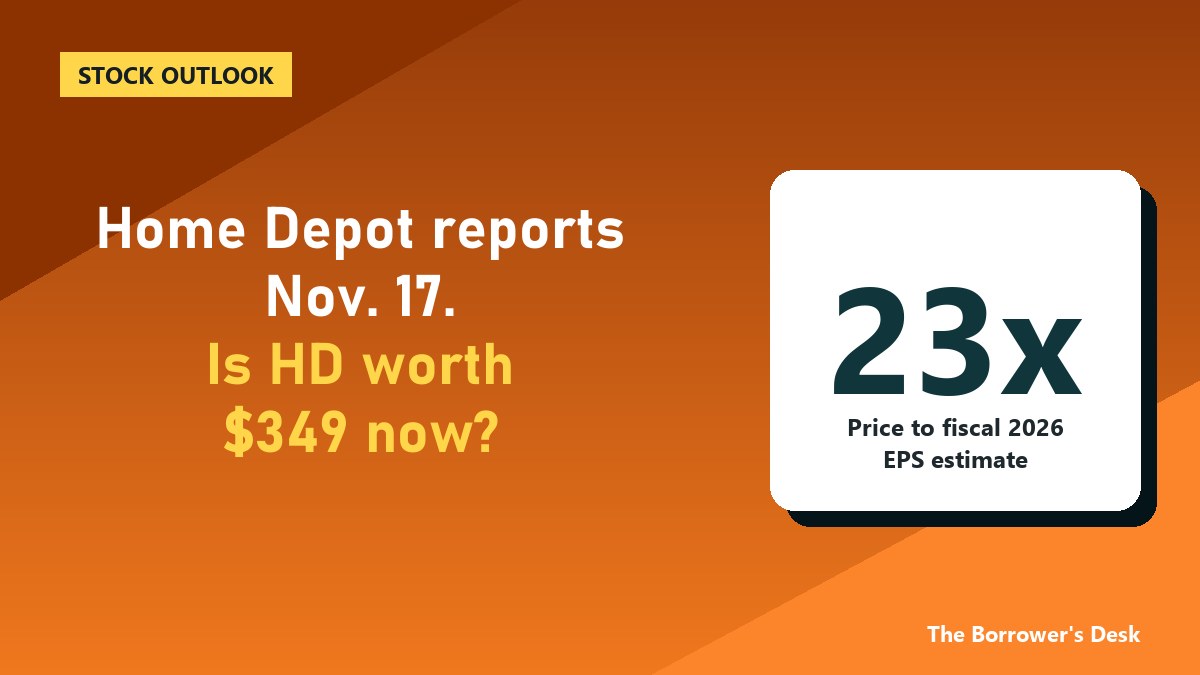
Home Depot reports its fiscal third quarter on Tuesday, November 17, 2026, before the market opens, with a conference call at 9 a.m. Eastern. The stock closed at $348.69 on November 13, about 4% lower than a year earlier and well below its 52 week closing high of $391.05.
The company did not give a forecast for the quarter alone. It gave one for the full year, and in August it reaffirmed that forecast after a second quarter it said beat its own expectations. This article walks through what Home Depot reported, what it promised for the year, what analysts expect on November 17, and what the stock costs at today’s price.
Company figures come from Home Depot’s second quarter earnings release, furnished to the SEC on Form 8-K on August 18, 2026, and its other filings. Analyst averages and the price come from Yahoo Finance as of November 13.
What the second quarter showed

For the quarter that ended August 2, 2026, Home Depot’s sales were $47.9 billion, up 5.7%. Adjusted diluted earnings per share were $4.92, up from $4.68 a year earlier. Analysts had expected $4.73, so the beat was 19 cents.
The details matter more than the headline:
- Comparable sales rose 1.7%, and 1.3% in the U.S. The gap between that and 5.7% total growth comes mostly from new stores and from acquired businesses such as SRS and GMS, which sell to professional contractors.
- Customers made fewer trips. Comparable customer transactions fell 1.0%, while the average ticket rose 2.8% to $92.50. People spent more per visit, but fewer visits happened.
- Margins were close to flat. The adjusted operating margin was 14.7%, against 14.8% a year earlier. Selling, general and administrative costs grew 8.5%, faster than sales.
Chief financial officer Richard McPhail said demand was broad, with customers “continuing to engage in smaller projects.” Read together with the drop in transactions, that points to steady spending on repairs and small jobs rather than a return of large remodels.
The full year guidance
Home Depot’s fiscal 2026 ends on January 31, 2027. In August the company reaffirmed every line of its outlook:
- Total sales growth of about 2.5% to 4.5%
- Comparable sales growth of about flat to 2.0%
- Adjusted operating margin of about 12.8% to 13.0%
- Adjusted EPS growth of about flat to 4.0% from $14.69, which works out to roughly $14.69 to $15.28
- About 15 new stores and capital spending of about 2.5% of sales
The guidance includes refunds of tariffs the company had paid under the International Emergency Economic Powers Act, known as IEEPA tariffs. Home Depot said those refunds are expected to partly offset fuel, energy and other input costs it had not planned for. So part of the year’s earnings depends on a one time item covering a cost that may stay.
Here is what the range implies for the second half. Adjusted EPS for the first half was $8.35. Subtracting that from the full year range leaves about $6.34 to $6.93 for the third and fourth quarters together. In the same two quarters last year Home Depot earned $3.74 and $2.72, or $6.46. The low end of the guidance means a small decline in the second half. The high end means growth of about 7%.
What analysts expect on November 17

Yahoo Finance’s averages as of November 13 are:
- Third quarter: EPS of $3.84 from 30 analysts, against $3.74 a year ago, and sales of $42.78 billion from 26 analysts, against $41.35 billion
- Fiscal 2026: EPS of $15.01 from 34 analysts, near the middle of the company’s range
- Fiscal 2027: EPS of $15.91 from 34 analysts
Yahoo labels these years by the calendar year in which they end, so it shows fiscal 2026 as “2027.” The numbers are the same.
The third quarter estimate implies growth of under 3%, and it has come down from $3.96 ninety days ago. More analysts have cut their estimates over the last month than raised them. The track record is mixed. Over the last four reported quarters, Home Depot beat the average estimate three times and missed once, in the third quarter of last year, by nine cents.
The average one year price target is $377.81, about 8% above the November 13 close.
What you pay at $349
Here is the price against the earnings numbers:
- About 23.7 times fiscal 2025 adjusted EPS of $14.69
- About 23.2 times the fiscal 2026 estimate of $15.01
- About 21.9 times the fiscal 2027 estimate of $15.91
That is less than half the multiple of Walmart, which we covered in our Walmart stock forecast at about 44 times this year’s estimate. The difference is growth. Analysts expect Home Depot’s earnings to grow about 2% this year and 6% next year, so investors are paying a lower price for slower growth.
The dividend is a bigger part of the case here. Yahoo Finance lists a forward dividend of $9.32 a year, or $2.33 a quarter, for a yield of about 2.7%. In the first half of the year Home Depot paid $4.6 billion in dividends. Its cash flow statement for those six months shows no share repurchases.
The CEO is on medical leave
On August 12, Home Depot announced that chair, president and CEO Ted Decker was taking a temporary medical leave and that it expected him to return “within the next few months.” Ann-Marie Campbell, senior executive vice president, oversees daily operations. McPhail oversees finance and the professional contractor businesses. Lead director Greg Brenneman chairs the board during the leave.
As of November 13, the company had not filed an update on his return with the SEC. The November 17 call is the first earnings call since August, so watch for any comment on leadership.
Three things to watch on November 17
Customer transactions. Comparable transactions fell 1.2% in the first half while the average ticket rose 2.5%. A ticket rising because of price increases is weaker than one rising because people take on larger projects. Watch for comments on large projects.
Whether the guidance holds. The company has kept its range unchanged so far. With analysts near the middle of it, a raise or a cut would likely move the stock more than the quarter’s own numbers.
Housing and rates. Home improvement demand tends to follow home sales and home equity. On November 13, Yahoo Finance showed the 10 year Treasury yield at 5.15%, and mortgage rates tend to move with it. Any comment on when larger remodels might return will matter more than the third quarter’s comparable sales.
Cash and debt
As of August 2, Home Depot had $2.1 billion in cash and about $52.9 billion of debt, including $4.2 billion of short term borrowings. Operating cash flow for the first half was $11.4 billion, up from $9.0 billion, and capital spending was $1.7 billion. The company also spent $1.3 billion on acquisitions in the half. Inventory was $26.8 billion, up 8.1% from a year earlier, faster than sales.
The bottom line on HD
Home Depot is still growing sales, mostly through stores and acquisitions, while its core store business grows slowly and traffic falls. The company has held its full year outlook, and analysts expect it to land near the middle.
At about 23 times this year’s estimated earnings with a 2.7% yield, the stock is priced for a slow recovery in home improvement, not a fast one. If you own it, the November 17 report is a check on whether the second half is tracking toward the top or the bottom of that range. If you are thinking of buying, the guidance and the comments on housing will tell you more than the quarter itself. For a look at how housing costs are affecting homeowners this year, see our guide on prepaying property taxes before December 31.
This article is based on Home Depot’s SEC filings and published analyst averages. It is not investment advice, and it does not predict where the stock will trade.

Leave a Reply