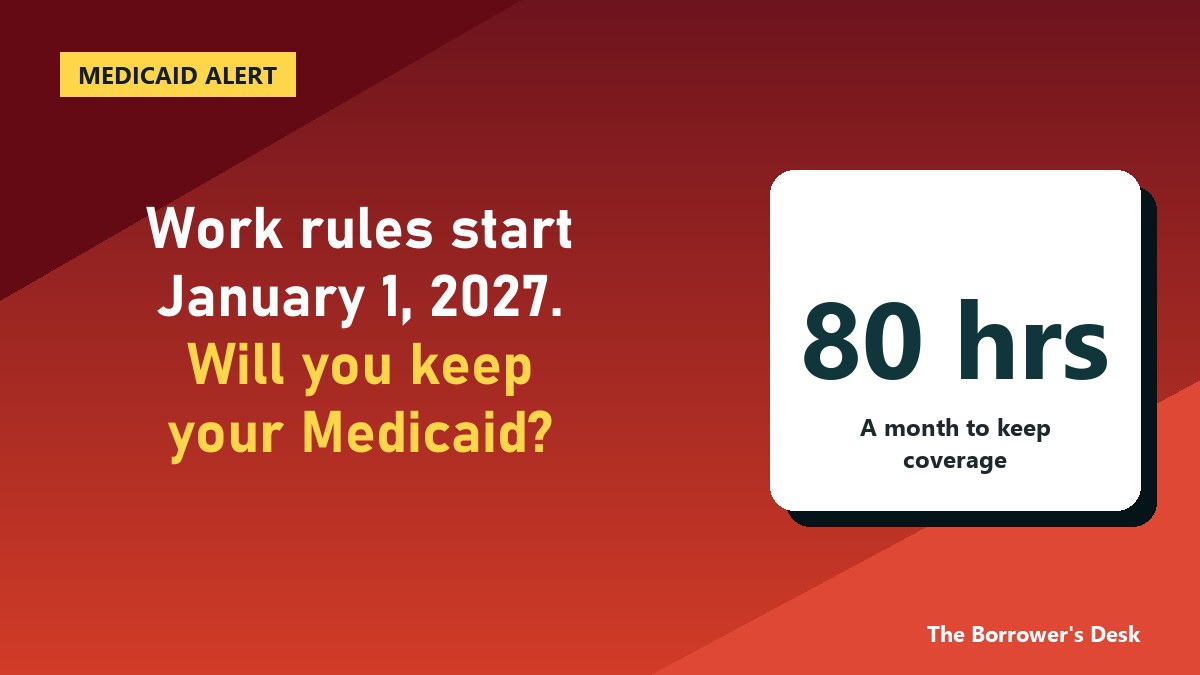
Starting January 1, 2027, millions of adults on Medicaid will have to show that they work, volunteer, go to school or earn a minimum amount each month to keep their coverage. States must warn enrollees months ahead, so notices are going out this fall, and many people will have to answer a letter or log in to a state portal to stay covered.
This is a federal rule, written into the 2025 tax and spending law and filled in by an interim final rule the Centers for Medicare and Medicaid Services (CMS) published in the Federal Register on June 3, 2026. Here is who it covers, who is exempt, what counts, and what to do before the deadline in your state.
The details below come from the CMS fact sheet on the rule, the rule itself (91 FR 33348), and the Congressional Research Service report on the law.
Who has to meet the requirement
The rule applies to adults 19 through 64 who get Medicaid through the expansion group, the coverage for low income adults that most states added under the Affordable Care Act. It also applies in states that cover the same adults through a special waiver.
It does not apply to:
- Children
- People 65 and older
- People who are pregnant
- People on Medicare
- People who qualify for Medicaid another way, such as through disability, or as a parent in a state’s traditional Medicaid program
If you are not sure which group you are in, call the number on your Medicaid card and ask if you are in the adult expansion group. Your approval or renewal letter may also name the coverage group.
What you have to do each month

You meet the requirement in a month if you do any one of these:
- Work at least 80 hours
- Do at least 80 hours of community service
- Take part in a work program for at least 80 hours
- Go to school at least half time
- Combine work, service, a work program and school to reach 80 hours
- Have monthly income of at least $580, which is 80 hours at the $7.25 federal minimum wage
The income test helps people with irregular schedules. Someone who earns $600 in a month meets the requirement even if they worked fewer than 80 hours. Seasonal workers can use their average monthly income over the past six months.
Who is exempt
The law lists groups that do not have to meet the requirement at all. Under the CMS rule, you are exempt if you are:
- A parent, guardian or caretaker relative of a child 13 or younger
- A caregiver for a person with a disability
- Pregnant or within the postpartum period
- A veteran with a total disability rating
- Medically frail, which includes blindness or disability, a substance use disorder, a disabling mental disorder, and certain serious or complex medical conditions
- In treatment for drug or alcohol use
- Meeting the work rules for TANF, or in a SNAP household and not exempt from the SNAP work rules
- An American Indian or Alaska Native
- A former foster youth under age 26
- An inmate, or released from jail or prison within the past three months
The medically frail exemption is the one most likely to cause problems. The CMS rule says the condition has to significantly impair your ability to meet the requirement. A diagnosis alone may not be enough. If you have a serious health condition, ask your doctor for a note describing how it limits your ability to work, and send it to your Medicaid office before your state checks.
States can also choose to grant short term hardship exemptions. These cover people in a hospital or nursing facility, people who must travel for medical care, people in a federally declared disaster area, and people in counties where unemployment is at least 8% or 1.5 times the national rate.
When your state starts
The federal deadline is January 1, 2027. Some states moved earlier. According to the KFF tracker updated November 3, 2026, Nebraska began enforcing the rule on May 1, 2026. Arkansas began a soft launch on July 1, with no one losing coverage before January 1, 2027. Iowa planned to start December 1, 2026.
States can ask CMS for a good faith exemption to delay. CMS can approve a delay six months at a time, but no delay can last past December 31, 2028. California filed such a request in October 2026. If your state is delaying, the start date in your notice will be later.
The rule requires states to send a notice months before they start checking. If you got a letter about community engagement or work requirements this fall, it is that notice. Do not throw it away.
How the state checks

States must first try to confirm your work, income or exemption from data they already have, such as state wage records or SNAP files. If the data shows you meet the requirement, you are not supposed to be asked for paperwork.
When the data does not settle it, the state will ask you to show proof:
- When you apply: the state checks one to three months before the month you apply, depending on the state’s choice
- At each renewal: the state checks at least one month since your last approval
- Renewals get more frequent: under a separate part of the same law, adults in the expansion group move to renewals every six months instead of once a year starting in 2027
If the state cannot confirm that you meet the rule, it must send you a notice. You then have 30 days from receiving it to show that you comply or that you are exempt. Before ending your coverage, the state also has to check if you qualify for Medicaid some other way. If you are cut off, you have the right to a fair hearing, and you can reapply.
What happens if you lose coverage
Losing Medicaid under this rule has a second cost. People denied or removed for not meeting the requirement are not eligible for premium tax credits on the ACA Marketplace for that time. That means no subsidized Marketplace plan as a fallback.
CMS’s own estimate in the rule is that about 2.3 million fewer people will be enrolled in fiscal year 2027, rising to 3.1 to 3.3 million in later years.
What to do before January
1. Find out if you are in the expansion group. Check your Medicaid letters or call your state agency. 2. Update your contact information. Notices go by mail, and a letter sent to an old address can cost you coverage. Update your mailing address, phone and email with your Medicaid office now. 3. Keep proof of hours or income. Save pay stubs, a letter from an employer, gig app earnings summaries, a school enrollment record or a volunteer coordinator’s letter. 4. Ask for an exemption in writing if you qualify. Parents of young children, caregivers and people with serious health conditions should not wait for the state to figure it out. 5. Answer every notice within the deadline. The 30 day window is short.
If you are not sure your income qualifies for Medicaid in the first place, our guide to Medicaid income limits for 2026 has the numbers by household size. If you earn too much for Medicaid, our article on ACA premium tax credit income limits covers Marketplace help. Households that also get food benefits can check the SNAP rules in our guide to SNAP income limits by household size.
This article explains the federal rule as published by CMS. Each state runs its own Medicaid program, and start dates, verification steps and optional exemptions vary. Your state Medicaid agency has the final word on your case.

Leave a Reply