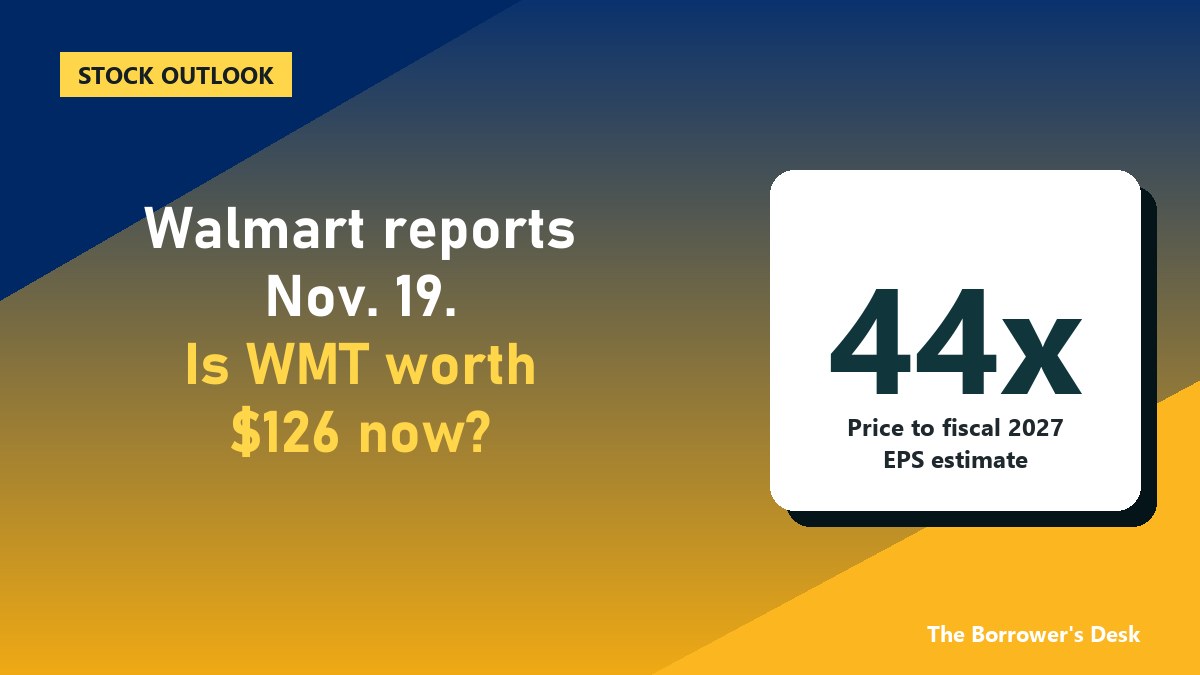
Walmart reports its fiscal third quarter on November 19, 2026, the week before Thanksgiving. The stock closed at $126.19 on November 12, up about 23% from $102.54 a year earlier and a few dollars under its 52 week closing high of $134.20.
The company has already told investors what to expect. In August it guided to adjusted earnings of $0.62 to $0.64 a share for the quarter, and it raised its forecast for the full year. This article walks through what Walmart reported last quarter, what it has promised for this one, what analysts expect, and what you are paying for the stock at today’s price.
All company figures come from Walmart’s second quarter earnings release, furnished to the SEC on Form 8-K on August 20, 2026. Analyst averages and the price come from Yahoo Finance as of November 12.
What the last quarter showed

For the quarter that ended July 31, 2026, Walmart’s revenue was $187.9 billion, up 5.9%, or 5.1% in constant currency. Adjusted earnings per share were $0.81. Analysts had expected $0.74, so the beat was large for a company this size.
Several lines stood out:
- Online sales grew 23% worldwide and 24% in the U.S., led by orders filled from stores for pickup and delivery, plus the third party marketplace.
- Advertising grew 38%. Walmart Connect, the U.S. ad business excluding VIZIO, grew 43%.
- Membership fee revenue grew 17% globally, and Walmart+ had its largest second quarter of new members on record.
- Walmart U.S. comparable sales rose 2.6%. That is slower than the 4.6% a year earlier, and the company said pharmacy deflation from new federal maximum fair price rules on certain drugs, in effect since January 1, cut 125 basis points from comps.
Operating income jumped 28.8% to a reported figure that included refunds of tariffs Walmart had previously paid. On an adjusted constant currency basis it rose 17.4%. The company said it is putting the remaining tariff refunds back into lower prices in the second half rather than keeping them as profit.
Reported net income attributable to Walmart fell 9.4% to $6.37 billion, because of a loss on equity investments. That loss is excluded from the adjusted figure.
The guidance for the November 19 report
Walmart gave specific numbers for the third quarter, measured against last year’s $177.8 billion of sales and $0.62 of adjusted EPS:
- Net sales up 3.0% to 3.75% in constant currency
- Adjusted operating income up 2.0% to 4.0%
- Adjusted EPS of $0.62 to $0.64
That sales range is slower than the second quarter. Chief financial officer John David Rainey gave one reason: Flipkart’s Big Billion Days sale in India moved from the third quarter into the fourth this year, a timing shift worth more than 100 basis points of growth. He also asked investors to look at the second and third quarters together, since tariff refunds lifted the second quarter and will be spent on prices in the third.
The guidance for the third quarter implies almost no growth in adjusted EPS from a year ago at the low end, and about 3% at the high end. That is the plan the company itself put on the table, so a quarter inside that range would be Walmart doing what it said.
The full year outlook was raised
For fiscal 2027, which ends January 31, 2027, Walmart raised all three main targets in August:
- Net sales growth of 4.0% to 5.0%, up from 3.5% to 4.5%
- Adjusted operating income growth of 7.0% to 8.5%, up from 6.0% to 8.0%
- Adjusted EPS of $2.80 to $2.87, up from $2.75 to $2.85, against $2.64 in fiscal 2026
It also raised planned capital spending to about 4.0% of net sales, from 3.5%. At roughly $740 billion of sales, that half point is several billion dollars more going into automation, stores and delivery this year.
What analysts expect

Yahoo Finance’s averages as of November 12 are:
- Third quarter: EPS of $0.63 from 34 analysts, inside the guided range, and revenue of $187.2 billion from 26 analysts
- Fiscal 2027: EPS of $2.89 from 40 analysts, slightly above the top of Walmart’s own range
- Fiscal 2028: EPS of $3.22 from 42 analysts
The full year estimate sitting above guidance matters. It means analysts already expect Walmart to raise its outlook again, or at least to land at the top. Over the last four reported quarters, Walmart matched or beat the average EPS estimate each time, by up to seven cents.
The average one year price target is $129.65, about 3% above the November 12 close.
What you pay at $126
Here is the price against the earnings numbers above:
- About 48 times fiscal 2026 adjusted EPS of $2.64
- About 44 times the fiscal 2027 estimate of $2.89
- About 39 times the fiscal 2028 estimate of $3.22
For a retailer, those are high multiples. Investors are paying for the parts of the business that are growing several times faster than the stores: advertising, membership fees and the marketplace.
Costco, which we covered in our Costco stock forecast, trades at about 48 times its own fiscal 2027 estimate. So both of the large discount retailers now carry valuations that leave little room for a disappointing year.
The dividend is not the reason to own this stock at this price. Walmart pays $0.248 a quarter, or $0.99 a year, a yield of about 0.8%. The next payment has an ex-dividend date of December 11, 2026. The company also bought back 42.3 million shares for $5.1 billion in the first half of the year and has $25.1 billion left on its $30 billion authorization from February 2026.
Three things to watch on November 19
U.S. comparable sales. The second quarter’s 2.6% included a 125 basis point drag from drug pricing. If comps excluding that effect hold up, it points to customers still shifting more of their spending to Walmart.
Where the tariff refunds went. The company said it would reinvest them into prices. Watch the gross profit rate. If it falls sharply, the reinvestment was large. If it holds, Walmart managed to cut prices and keep margin.
The fourth quarter and full year guidance. With analysts at $2.89, above the top of the $2.80 to $2.87 range, the updated range will probably move the stock more than the quarter’s own numbers. The fourth quarter also includes the holiday season and the Flipkart sale that moved out of the third quarter.
Cash and debt
As of July 31, Walmart had $11.5 billion in cash and $57.2 billion in total debt. Operating cash flow for the first half was $19.7 billion, up $1.4 billion, but free cash flow fell $1.4 billion to $5.5 billion because of the higher capital spending. Inventory rose 6.7% to $61.6 billion, which the company attributed to strategic initiatives and inflation. Inventory growing faster than sales is worth watching heading into the holiday quarter.
The bottom line on WMT
Walmart’s business is in good shape by its own numbers. Online sales, advertising and membership are growing much faster than the stores, and the company raised its full year targets in August. What the stock price already reflects is the other half of the story. At 44 times this year’s estimated earnings, the shares assume that this keeps happening for years.
If you own it for the long term, the November 19 report is a check on whether that is still on track. If you are thinking of buying, it is worth knowing that the price already includes analyst expectations above the company’s own guidance. Our Amazon stock forecast covers the main competitor in online retail.
This article is based on Walmart’s SEC filings and published analyst averages. It is not investment advice, and it does not predict where the stock will trade.

Leave a Reply