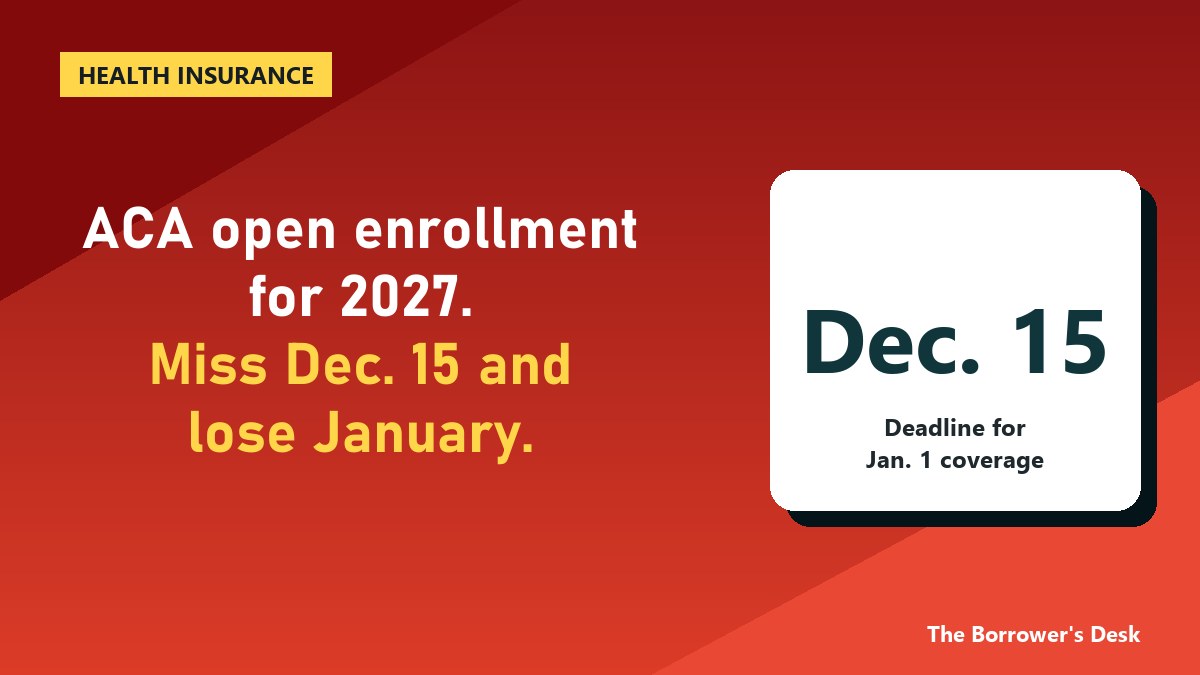
If you buy your own health insurance through HealthCare.gov, the date that matters this year is December 15, 2026. Pick a plan by then and your 2027 coverage starts January 1. Pick one between December 16 and January 15 and it starts February 1, which leaves you with a month of no coverage unless your 2026 plan somehow continues.
Open enrollment for 2027 runs from November 1, 2026 to January 15, 2027 on HealthCare.gov, according to the CMS plan year 2027 fact sheet published October 30. Several states that run their own marketplaces give you longer. This guide covers the dates, why letting your plan renew on its own is riskier than usual this year, and the few things worth doing before the deadline.
The deadlines, by state

Most states use HealthCare.gov, and for them the rules above apply. States with their own exchange can set their own dates:
- California (Covered California): open until January 31, 2027. Choose by December 31 for January 1 coverage.
- New York (NY State of Health): open until January 31. The state asks people to enroll by December 15 for January 1 coverage.
- New Jersey (GetCoveredNJ): open until January 31. Choose by December 31 for January 1 coverage. January sign ups start February 1.
- Pennsylvania (Pennie): open until January 15. Choose by December 15 for January 1 coverage.
- Massachusetts Health Connector: open October 23 to January 23. Choose by December 23 for January 1 coverage.
- District of Columbia (DC Health Link): open until January 31. Choose by December 15 for January 1, by January 15 for February 1, and by January 31 for March 1.
In every case, coverage only starts once the first month’s premium is paid. Choosing a plan is not enough by itself.
You may have read that open enrollment was being cut to end December 15 everywhere. A 2025 federal rule would have done that starting with 2027 coverage, but a federal court in Maryland vacated that part of the rule in June 2026, and CMS said in July that it had not changed the open enrollment dates. The government has appealed, but the 2027 dates above stand.
Why “do nothing” is risky this year
If you are already enrolled and do nothing, the marketplace will usually renew you into the same plan, or a similar one if yours is discontinued. That is still how it works for 2027. The problem is what renews with you.
Premiums went up again. KFF found that benchmark silver premiums for 2027 rose 13% on average, 11% in HealthCare.gov states and 16% in states with their own exchanges, on top of a 26% jump for 2026. The national average benchmark is about $703 a month before any credit.
The extra help is gone. The larger premium tax credits that started in 2021 expired after 2025. As of mid November 2026, Congress has not passed an extension into law. That means the 400% of poverty limit is back. Above that income, you get no credit at all, no matter how high the premium.
Your credit depends on your income estimate. The amount of help you get each month is based on the income you report for the coming year. If you renew automatically, the marketplace uses the information it already has. If your income has changed, the credit may be too high or too low.
The repayment limit is gone. This is the part that can hurt. Starting with tax year 2026, the cap on paying back extra premium credits no longer exists, under the 2025 tax law. If your monthly credit was based on an income estimate that turned out too low, you now owe back the whole difference when you file. Before, many households owed back a capped amount. Now there is no ceiling.
What you pay in 2027

Under IRS Rev. Proc. 2026-26, the most you are expected to pay for the benchmark silver plan in 2027 ranges from 2.15% to 10.22% of household income, depending on where your income falls against the poverty line:
- Under 133% of the poverty line: 2.15%
- 133% to 150%: 3.23% to 4.30%
- 150% to 200%: 4.30% to 6.78%
- 200% to 250%: 6.78% to 8.66%
- 250% to 300%: 8.66% to 10.22%
- 300% to 400%: 10.22%
- Over 400%: no credit
The credit covers the gap between that share of your income and the benchmark premium where you live. If you pick a cheaper plan than the benchmark, the credit goes further. If you pick a more expensive plan, you pay the difference. CMS says more than 75% of HealthCare.gov enrollees can find a plan for $50 a month or less after credits.
For dollar figures by income and family size, see our breakdown of how much ACA coverage costs in 2027. For the poverty line amounts each program uses, see our 2026 federal poverty level chart.
Coverage costs more if you get sick, too. The 2027 out of pocket maximum for marketplace plans is $12,000 for one person and $24,000 for a family, up from $10,600 and $21,200 in 2026.
Who lost eligibility
Some people who had help in 2026 will not have it in 2027:
- Lawfully present immigrants with income under 100% of the poverty line lost premium credits starting January 1, 2026.
- Starting January 1, 2027, premium credits are limited to green card holders, Cuban and Haitian entrants, and people from the Compact of Free Association countries. Refugees, people granted asylum and trafficking survivors lose eligibility for the credits.
- DACA recipients have not been eligible for marketplace coverage since August 25, 2025.
The monthly special enrollment period for people with income under 150% of the poverty line has also ended. In past years, those households could sign up any month. For 2027 they need to enroll during open enrollment or qualify for a regular special enrollment period, such as losing other coverage.
If you are losing marketplace eligibility, check Medicaid in your state. Note that many adults on Medicaid expansion face new work reporting rules starting January 1, 2027, covered in our guide to Medicaid work requirements.
What to do before December 15
Log in and update your income. Use your best estimate of 2027 household income, not last year’s number. Count wages, self employment profit, unemployment and taxable Social Security. With no repayment cap, a careful estimate matters more than it used to.
Compare plans, even if you like yours. Your current plan’s price changed, and so did the benchmark. A plan from a different insurer, or a different metal level, may cost less after credits.
Look at cost sharing reductions. If your income is under 250% of the poverty line, a silver plan comes with lower deductibles and copays. A cheaper bronze plan does not. Many people in that range do better with silver even when bronze costs less per month.
Check doctors and drugs. Insurers change networks and drug lists every year. Search for your doctors and prescriptions inside each plan before you choose.
Pay the first premium. Your coverage does not start until the insurer receives it. Mark the due date the insurer sends you.
Report changes during the year. If your income rises or falls in 2027, update your application within 30 days. That keeps the monthly credit close to what you will end up qualifying for.
Bottom line
On HealthCare.gov, December 15 is the date for coverage on January 1, and January 15 is the last day to enroll for 2027. Premiums rose about 13%, the extra federal help has ended, and any credit you get beyond what your final income supports now has to be paid back in full. Letting the plan renew on its own is the easy choice, but this is a year to log in, update your income and compare plans before December 15. If you are not sure you qualify for a credit at all, our guide to premium tax credit income limits walks through it.
Official sources: HealthCare.gov dates and deadlines, IRS Publication 974.
Dates and figures come from CMS, IRS Rev. Proc. 2026-26, KFF and the state exchanges listed above, as of November 15, 2026. Rules can change, so confirm deadlines on your marketplace’s website.

Leave a Reply