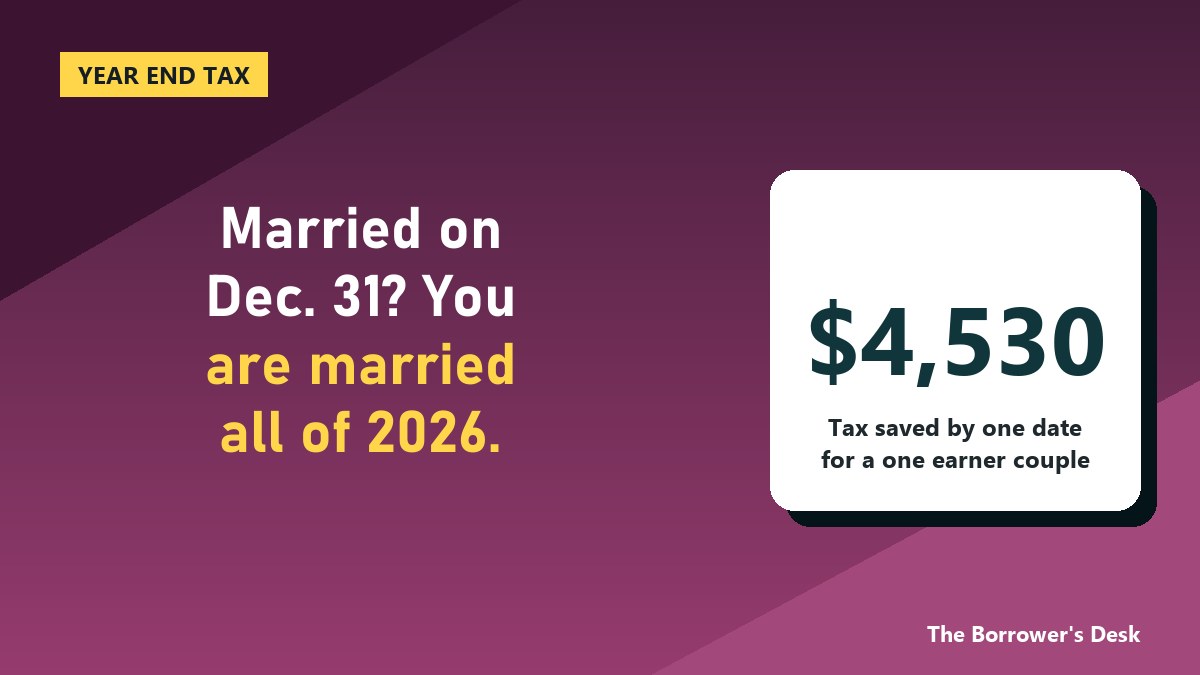
If you get married on December 31, the IRS treats you as married for all 365 days of 2026. Wait until January 1 and you were single all year. For a couple where one person earns $90,000 and the other earns nothing, that one day is worth $4,530 in federal income tax for 2026. For a low income couple with children, the same date can cost more than $5,800 in earned income credit.
The calendar does not care how long you have been together, and neither does the tax code. What counts is your status at midnight on New Year’s Eve. If a wedding or a divorce is anywhere near the end of the year, it is worth running the numbers before you pick the date.
The rule: December 31 decides the whole year
IRS Publication 501 is plain about it. You are considered unmarried for the whole year if, on the last day of the tax year, you are unmarried or legally separated under a divorce or separate maintenance decree. If you are married on that day, you are married for the whole year.
Three situations follow from that:
- A wedding on or before December 31 lets the couple file a joint return for 2026, or separate married returns. Single filing status is no longer available to either of them for that year.
- A divorce decree that becomes final by December 31 makes both people unmarried for all of 2026. Neither can file jointly. Each files as single, or as head of household if they qualify.
- A spouse who dies during the year does not change the survivor’s status. The survivor is still considered married for that year and can file a joint return.
There is one guardrail. Publication 501 says that if a couple divorces only to file as unmarried and then remarries in the next year, they must file as married for both years. The IRS looks at what happened, not just the paperwork.
Who wins, who loses

Whether marriage cuts your tax or raises it depends on how the two incomes compare. Here is what the 2026 federal brackets and standard deductions do in four common cases. The figures use ordinary wage income and the standard deduction, which is $16,100 for a single filer and $32,200 for a married couple filing jointly.
Case 1: One earner, one person at home or in school
One partner earns $90,000 and the other has no income.
- Unmarried: the earner files single. Taxable income is $90,000 minus $16,100, or $73,900. The tax is $10,970, and part of the income reaches the 22% bracket.
- Married filing jointly: taxable income is $90,000 minus $32,200, or $57,800. The tax is $6,440, all of it in the 10% and 12% brackets.
The couple saves $4,530 by being married on December 31. This is the classic marriage bonus. The joint return spreads one income across brackets that are twice as wide.
Case 2: Two similar earners
Each partner earns $60,000.
- Unmarried: each files single with $43,900 of taxable income and pays $5,020. Together, $10,040.
- Married filing jointly: taxable income is $87,800 and the tax is $10,040.
No difference at all. For 2026, every joint bracket line up to $512,450 is exactly double the single line, and the joint standard deduction is double the single one. Two people with similar pay below the top bracket pay the same either way.
Case 3: A low income parent marries a working partner
This is where the penalty hides. A single parent with two children earns $25,000 and files as head of household. The partner earns $35,000 and has no children.
- Unmarried: the parent’s earned income credit for 2026 is about $7,082, close to the maximum of $7,316 for two children, because the phaseout for single filers with children starts at $23,890.
- Married filing jointly: the couple’s earned income is $60,000. The joint phaseout starts at $31,160, and the credit shrinks by 21.06 cents for every dollar above that. It falls to about $1,242.
The couple loses roughly $5,840 of refundable credit by marrying before the end of the year. The joint return helps in other places: the partner’s tax drops and more of the child tax credit can be used. Counting income tax, the child tax credit and the earned income credit together, the couple still ends up about $5,635 worse off married than single for 2026. Our EITC calculator shows both versions if you enter each. To compare the whole return, married and single, use our marriage penalty calculator.
Case 4: Two homeowners in a high tax state
The state and local tax deduction is capped at $40,400 for 2026, and the cap is the same for a single filer and a married couple filing jointly. Two single homeowners who each pay $30,000 in property and state income tax can each deduct the full $30,000 if they itemize. Married, they share one $40,400 cap and lose $19,600 of deductions between them. Our guide to prepaying property taxes under the new SALT cap covers how the cap works.
At the very top, the 37% bracket starts at $640,600 for a single filer but only $768,700 for a joint return, well short of double. Couples where both earn several hundred thousand dollars can owe more married.
The catch most people miss: benefits count both incomes

Taxes are only half of it. Most benefit programs look at household income, and a spouse’s paycheck counts from the day you are married, not from December 31.
- ACA premium tax credit. The credit for 2026 is figured on the household income on your tax return. If you marry during the year, the combined income on your joint return decides how much credit you were entitled to, and the credit runs from 100% to 400% of the poverty level. A couple whose combined income passes 400% may have to repay advance payments, and for 2026 there is no cap on that repayment. IRS Publication 974 has an alternative calculation for the year of marriage that can lower the amount owed, so ask for it if this applies to you. Marriage is also a life event that opens a Special Enrollment Period on HealthCare.gov.
- SNAP and Medicaid. Married people who live together are generally one household for both. Combined income can push a household over the line. Our poverty level calculator shows where a combined income falls against each program’s limit.
- SSI. Supplemental Security Income has its own couple rate and counts a spouse’s income and resources, which often lowers the payment when someone on SSI marries.
None of this is a reason to change wedding plans. It is a reason to know the numbers so that a smaller refund or a benefit letter in February is not a surprise.
Divorcing near the end of the year
The same date works in reverse. If a divorce is final by December 31, you file 2026 as unmarried. If it is still pending on that day, you are married for the year and choose between a joint return and married filing separately.
Even with the divorce still pending, you may file as head of household if you count as considered unmarried under Publication 501. That requires all of the following for 2026:
- You file a separate return.
- You paid more than half the cost of keeping up your home for the year.
- Your spouse did not live in your home during the last six months of the year.
- Your home was the main home of your child, stepchild or foster child for more than half the year, and you can claim the child as a dependent, with an exception for some divorced and separated parents.
Head of household brings a $24,150 standard deduction and wider brackets than married filing separately, so it is worth checking before you assume the worst.
What to do before December 31
Run the return both ways. Use last year’s return or a free tax estimator to compare a joint return with two single returns. Ten minutes with real numbers tells you whether the date matters for you.
Look at the credits, not just the brackets. For lower income couples, the earned income credit, the child tax credit phaseouts and the ACA credit often move more money than the tax rates do.
Update your W-4. Two people who each had withholding set up as single can end up underwithheld as a married couple, especially when both work. The IRS Tax Withholding Estimator handles two jobs. Our guide to checking your W-4 before year end walks through it.
Match your name to Social Security. If you change your name, update it with the Social Security Administration before you file. A name on the return that does not match Social Security records can delay processing and the refund.
Report the change to benefit programs. Tell the Marketplace, your state Medicaid or SNAP office and Social Security about the marriage. Reporting late can mean repaying benefits later.
The short version
Your marital status on December 31 sets your filing status for the whole year. A couple with one main earner usually saves by marrying before the year ends. Two similar earners below the top bracket see no change. Low income couples with children and two high tax homeowners can lose real money. If your date is flexible and the difference is in the thousands, it is legal to let the numbers inform it. The IRS only draws the line at a divorce and remarriage done purely for taxes.
Figures are federal, for tax year 2026, from the IRS inflation adjustments released for the year and Publication 501. State taxes and benefit rules differ. This is general information, not tax advice.
Official sources: IRS Publication 501, filing status, IRS tax year 2026 inflation adjustments, HealthCare.gov special enrollment, IRS Tax Withholding Estimator, IRS Publication 974, premium tax credit.

Leave a Reply