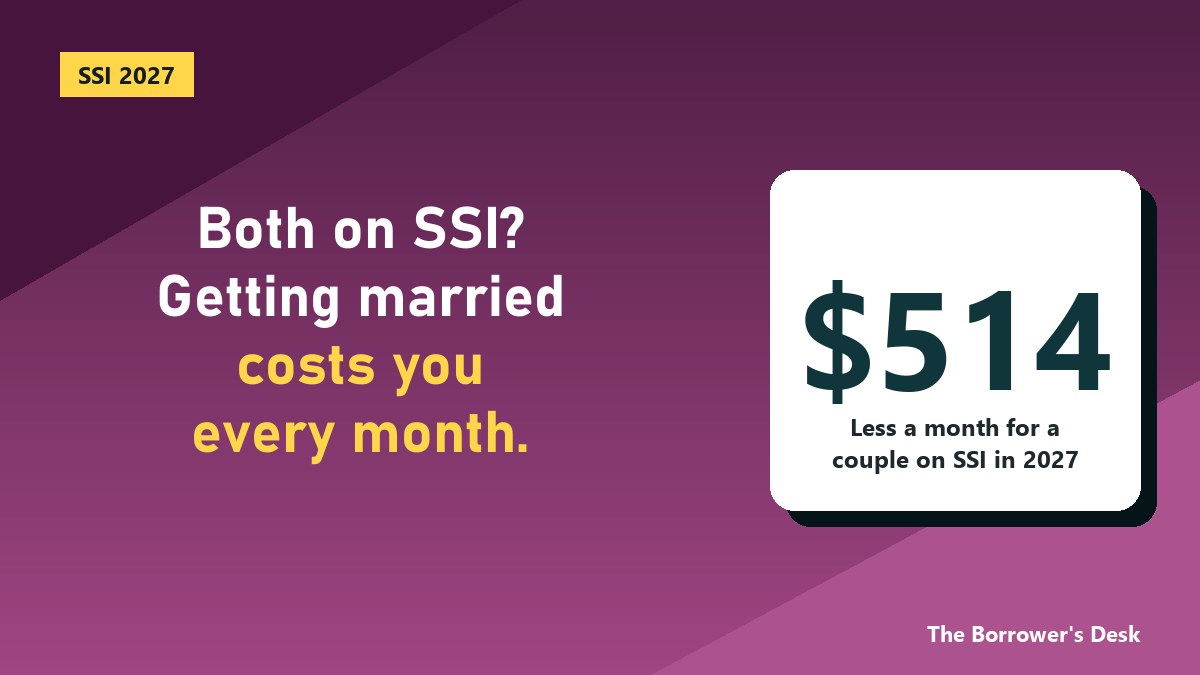
Two people who each receive the full federal SSI payment get $2,058 a month between them in 2027. If they marry, the couple rate is $1,544. That is $514 a month less, or $6,168 a year, for signing a marriage license. And for couples who also have other income, such as a small Social Security check, the cut can be the whole SSI payment.
This is the SSI marriage penalty. It is written into the Social Security Act, it has been criticized in Congress for years, and it is still the law for 2027. It also reaches people who never marry: Social Security can treat two people as a married couple if they live together and present themselves as one.
This guide shows how the math works for three kinds of households, what counts as being married for SSI, and which choices change the numbers.
Why the couple rate is lower
SSI pays a federal benefit rate that rises each January with the cost of living adjustment. For 2027, after the 3.6% increase, it is $1,029 for one person and $1,544 for an eligible couple, according to the Social Security Administration. In 2026 the figures were $994 and $1,491.
The couple rate is set at 1.5 times the individual rate, not 2 times. The idea, from when SSI began in 1974, is that two people living together share rent, food and utilities, so they need less than two people living apart. SSA’s own policy paper on married couples traces the rule to that assumption.
Resources follow the same pattern. A single person may have up to $2,000 in countable assets. A couple may have $3,000, not $4,000. Those limits have not changed since 1989.
Three households, before and after

The numbers below use the 2027 federal rates and assume both people are aged, blind or disabled and eligible for SSI. State supplements are left out.
Household one: no other income. As individuals, each gets $1,029, for $2,058. As a couple they get $1,544. The loss is $514 a month.
Household two: each has $800 a month in Social Security. As individuals, SSA subtracts a $20 general exclusion from each person’s $800, leaving $780 of countable income. Each gets $1,029 minus $780, or $249 of SSI, for $498 combined. As a couple, the $800 checks are added together to $1,600, and the $20 exclusion is taken only once. Countable income is $1,580, which is more than the $1,544 couple rate. SSI drops to zero. In most states, losing SSI can also affect automatic Medicaid, so the real loss can be larger than the $498.
Household three: one person works. One partner earns $1,000 a month and the other has no income. As individuals, the worker’s countable earned income is $1,000 minus $20 and $65, then half of the rest, which is $457.50, so that person gets $571.50 of SSI. The other gets the full $1,029. Together that is $1,600.50. As a couple, the exclusions are applied once to the combined income, countable income is still $457.50, and the couple gets $1,544 minus $457.50, or $1,086.50. The loss is $514, the same as with no income.
So for couples who both still get some SSI, the penalty is usually at least the gap between two individual rates and one couple rate. It can grow when there is other income, because the exclusions that each single person would get are given to the couple only once, and because one partner’s income now reduces a payment the other partner shares.
What counts as married for SSI

Under 20 CFR 416.1806, SSA treats you as a couple if any of these is true:
- You are legally married under the law of your state.
- You would be treated as married for Social Security benefits, for example under a state’s rules on common law marriage.
- You live together and hold yourselves out as a married couple. SSA asks if you present yourselves to your community as husband and wife or spouses. A shared last name, a joint lease that calls you married or telling neighbors you are married can all count. SSA’s operating manual applies this rule to same sex couples too.
Simply living with a partner does not make you a couple for SSI if you do not hold yourselves out as married. Each of you still files as an individual. Living together can still lower SSI for another reason: if one partner pays your rent or food, SSA may count that support as income in kind. That is a separate rule from marriage.
If a couple separates, SSA treats them as individuals beginning the month after the month they stop living in the same household.
When only one spouse is on SSI
The rules above are for two eligible spouses. When only one spouse is aged, blind or disabled and gets SSI, the other spouse is called an ineligible spouse. SSA then may count part of the ineligible spouse’s income as available to the SSI recipient, a process called deeming. If the ineligible spouse earns a regular paycheck, deeming can reduce SSI sharply or end it. SSA leaves out an amount set aside for each ineligible child in the home, and deeming applies only when the spouse’s income is above a set level, so a small income may not matter.
What marriage does not change
SSDI. Social Security Disability Insurance is based on your own work record. Marriage does not lower an SSDI check, and the spouse’s income does not count. That is why couples where both partners get only SSDI can marry without this penalty.
Childhood disability benefits. The rule is different for adults who get benefits on a parent’s record as a disabled adult child. Marriage generally ends those benefits unless the spouse also receives certain Social Security benefits. Ask SSA about your case before marrying.
Medicaid. Medicaid rules differ by state. In states where SSI brings Medicaid automatically, losing SSI can mean applying separately. Some disabled workers keep Medicaid through state buy in programs.
Choices that change the numbers
1. Run both versions first. Our SSI marriage penalty calculator compares two individuals with a couple using your incomes. 2. Ask about ABLE accounts. A person who became disabled before age 46 can save in an ABLE account, starting in 2026, without the money counting toward the $2,000 or $3,000 resource limit, up to $100,000 for SSI purposes. 3. Report any change within 10 days of the month’s end. Marriage, moving in together and separation all must be reported. Late reporting is the most common cause of SSI overpayments. 4. Check the state supplement. Many states add money to the federal rate, and the couple and individual amounts differ by state. 5. Get advice before the wedding. Benefits counselors at Work Incentives Planning and Assistance projects give free advice to people on SSI and SSDI.
Our guide to SSI payment amounts for 2027 explains how SSA counts income in more detail, the SSI calculator works out a single person’s payment, and our SSDI payments in 2027 guide covers the work based program. If you are weighing a December wedding for tax reasons, see what marrying on December 31 does to your tax year.
The bottom line
For two SSI recipients with no other income, marriage costs $514 a month in 2027. For couples who each have a small Social Security check, it can end SSI altogether. Holding yourselves out as married can trigger the same result without a wedding. Run the numbers, talk to a benefits counselor and report every change on time.
The examples use federal rates only and leave out state supplements, in kind support and deeming.
Official sources: SSA 2027 COLA fact sheet, 20 CFR 416.1806, who SSA treats as married, SSA policy paper, treatment of married couples in SSI, SSA, SSI income rules, SSA, SSI resources, SSA, ABLE accounts and SSI.

Leave a Reply